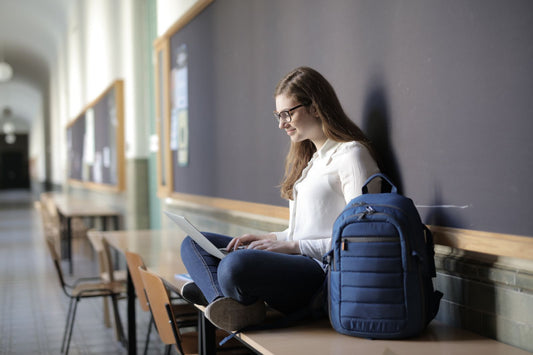


A college backpack has one of the hardest jobs in the bag world: carry 6–10kg of textbooks, laptop, and gym clothes across campus, four to six times a day, for four years. Most $40 "back to school" packs fail by sophomore year. Here's the spec sheet that actually survives college — and the features worth paying for.
Step 1: Get the size right (25–30L for most students)
Underclassmen with heavy textbook semesters: 28–32L. Upperclassmen who carry mostly a laptop and a notebook: 22–26L. STEM students with lab notebooks and bigger textbooks: 30–35L.
Step 2: Prioritize ergonomics (your back will thank you)
A college backpack at 7kg+ for 6 hours a day is medical equipment, not a fashion accessory. Non-negotiables:
- Framesheet — keeps the load rigid against your back. Pick up the empty pack and try to fold it. If it bends in half, skip it.
- S-curved padded shoulder straps — 3–4 inches wide, mesh-vented.
- Sternum strap — redistributes 15–20% of load off your shoulders.
- Padded hip belt — essential if your typical load is 7kg+. Saves your lumbar spine.
- Ventilated back panel — mesh-covered foam. You'll thank yourself in September.
Step 3: Pick a real material
For 4-year survival under daily abuse:
- Cordura® 500D nylon — the benchmark. Resists abrasion against lockers, lecture-hall floors, and gym bag straps.
- Recycled rPET 600D — increasingly common, durable, more sustainable.
- Avoid: polyester under 300D, cotton canvas (heavy when wet), unlined denim, faux leather.
Step 4: Compartments that match a class day
- Quick-access top pocket — student ID, keys, AirPods, charging cable.
- Dedicated laptop sleeve — padded, fits 13–16" laptop, suspended (doesn't touch bottom of pack).
- Tablet/notebook slot — next to the laptop sleeve.
- Main compartment with internal organization — pen slots, zip pocket for cash/cards, pen loops.
- Two external water bottle pockets — hold a 32oz Nalgene or Hydro Flask.
- External quick-stash pocket — for a snack, a sweater, or a folded textbook.
- Optional: a separate shoe / wet compartment — for gym days.
Step 5: Features worth paying for
- YKK zippers — the only zipper that survives 4 years of daily abuse. Check the small zipper logo.
- Reinforced bottom — either a rubberized panel or extra layer of Cordura®. The bottom of your pack lives on dorm floors, lecture-hall carpets, and gym lockers.
- Luggage pass-through — for flights home and spring break.
- Reflective accents — walking home from the library at midnight.
- Lockable zipper pulls — securing your laptop in a shared dorm room.
Features that are overkill at this price point
- Built-in chargers / USB ports — they break, and most students have a pocket charger already.
- Hyper-detailed photography dividers — unless you're a photo major, skip the camera-specific packs.
- Anti-theft "slash-proof" mesh — college campus theft is mostly opportunistic; lockable zippers are sufficient.
- Hydration bladder compatibility — you're not on a 6-day backcountry trip.
Best fit for different majors
Liberal arts, business, humanities: 22–26L, lightweight, laptop sleeve, sternum strap. Single textbook per class plus a laptop.
STEM (engineering, biology, chemistry): 28–35L with framesheet, hip belt, and a wide opening main compartment for big textbooks and lab notebooks.
Architecture, design, art: a pack with an external sleeve large enough for a 18x24" portfolio, plus 25–30L main capacity.
Athletes: 28–32L with a separate shoe compartment and a wet/dry divider. Sternum strap is essential.
Pre-med / nursing: 28–32L with framesheet (those biology textbooks are heavy), laptop sleeve, and a separate compartment for scrubs/lab coat.
Price tiers, honestly
- $40–$70 — will last 1–2 years if you're easy on it. Acceptable for first year.
- $80–$140 — the sweet spot. Will survive 4 years and graduation.
- $150–$250 — premium materials, lifetime warranty, ergonomic chassis. Worth it if you'll carry it into grad school or your first job.
For student government, athletics departments, and orientation programs
If you're sourcing branded backpacks for a college program (orientation kits, athletic team gear, scholarship recognition), the spec is identical — plus your school's Pantone match, embroidery or screen print of the logo, and inside-label customization. Backper's Custom & Branded line handles college programs from 50 units, with Pantone match free at 500+ and lead times around 3 weeks.
The bottom line
A great college backpack is a $100–$140 investment that lasts the whole four years. The features that matter — framesheet, hip belt, ergonomic straps, real fabric — cost more upfront but cost less than replacing two $50 packs and a chiropractor bill.
Buying for a campus store, a school or a client? We supply these styles wholesale — browse school, laptop backpacks and custom & branded. MOQ 50, volume discounts to 29%, UK/EU DDP delivery. Request a quote and we'll reply within 4 hours.
Tags:
Previous
Waterproof vs Water-Resistant Backpacks: The IP Rating (and the EU PFAS Deadline) Buyers Miss
Next
How to Organize Your Backpack Efficiently: Compartments, Packing Tips, and Daily Setup