


What 800 factory workers eat at noon tells you more about a supplier than any audit.
The bell
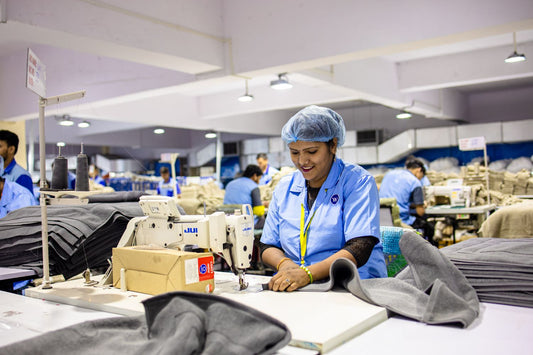
At 11:50 the sewing floor in Dongguan is a wall of sound — four hundred machines, compressed air, the thump of bartackers. At 12:00 it stops so completely that you can hear the rain on the roof. Lines don't trickle out; they release in a choreography everyone knows. By 12:04 the cafeteria — a hall the size of two basketball courts on the ground floor of dormitory block B — is seating its first shift of four hundred, and the woks at the back are already on their second round.
What's actually for lunch
The day we visited: rice, obviously, from steel vats refilled by trolley. Braised pork with bamboo shoots. Mapo tofu going fast at the Sichuan station, because a third of this floor is from Sichuan and Chongqing and the factory learned years ago that homestyle spice is cheaper than turnover. A vegetable stir-fry, winter melon soup, and — the detail we keep telling people — a halal station with its own cook, because eleven workers on the cutting floor are Hui. Lunch is free. That isn't standard in the industry. It's a line item the owner defends every budget cycle.
Why we audit the cafeteria
Here's the uncomfortable truth about formal audits: factories prepare for them. The paperwork is ready, the fire extinguishers are inspected that morning, the line leaders are briefed. A cafeteria can't be staged on short notice. Food is a recurring, unglamorous cost paid 26 days a month where nobody from compliance is looking — which is exactly what makes it diagnostic.
A factory that feeds people properly is telling you its real position on three things at once. Cash flow: meal programs are among the first costs squeezed when an owner is in trouble, so good food is a solvency signal no balance sheet will give you. Retention: skilled sewers in the Pearl River Delta can change employers in a weekend, and a factory with a good kitchen and low turnover keeps the six-year veterans whose seams never come back as warranty claims. And management attention: an owner who knows the canteen menu knows the floor; an owner who has to ask a deputy has managers between him and reality.
Retention isn't a soft metric here — it's the industry's most stubborn number. Peer-reviewed research on China's manufacturing labor market puts sector-wide worker turnover at 35.6% in 2011 and still 28.9% in 2015, the highest of eleven industries surveyed in both years, despite wages rising in the same period. Worth being precise about what that is and isn't: it's a national manufacturing-sector figure, not a Dongguan-specific or garment-specific one, and we haven't found a factory-floor number as current as this year. But it's the right order of magnitude for what a bad kitchen costs an owner — roughly one in three workers walking, year after year, industry-wide.
The corner table
We ate at a corner table with two line leaders and a mechanic, all of whom found it funny that the foreign visitors wanted the canteen instead of the banquet restaurant across the road. The mechanic, nineteen years at this factory, delivered the line of the trip while ladling soup: "When the food gets worse, people start looking at job boards before payday." Nineteen years of labor-market analysis in one sentence.
His comment matches our data in reverse. Among the factories we work with, the ones we'd rank top three on food are also top three on tenure — and the correlation between tenure and stitch quality is the closest thing this industry has to a law of physics.
The takeaway for buyers
If you visit a factory — and for any program over a thousand units, you should — skip one boardroom hour and eat lunch where the workers eat. Don't announce it. Look for fresh food cooked in volume, prices workers can actually afford (or no prices at all), managers eating the same food in the same hall, and tables mixed across departments. None of it appears in any audit rubric, including, we admit, our own 47-point one. But we've never been disappointed by a factory with a good cafeteria, and we no longer ignore a bad one. The kitchen is the audit the factory doesn't know it's taking.
The numbers behind this: China manufacturing-sector turnover, 35.6% (2011) and 28.9% (2015), highest among 11 surveyed industries — Liu & Zhu, "Why workers' turnover is so high," The Journal of Chinese Sociology (Springer, 2020), checked 17 Aug. 2026. Everything else in this piece is a first-hand account from our own factory visit, not a cited statistic.
Related reading: For the formal 47-point framework we run alongside this kind of unannounced visit, see What gets measured: the audit framework we wrote for our factories.
Tags:
Previous
The strange physics of webbing under shock load.
Next
Why the lid pocket is the most contested 0.6 liters on a pack.
Related articles

-
Jun 03 2026
We made every pack 2mm wider. Returns dropped 18%.
-
Jun 03 2026
Northwind Outdoor: 14 stores, one private-label catalog.


-
Jun 03 2026