
Custom Tactical Backpacks Wholesale: What PALS Actually Specifies, and What Mil-Spec Has to Cite

Rewritten 10 August 2026 — this guide has been rebuilt on military specifications, granted patents, the tariff schedule and federal procurement statute. Its central technical claim was wrong and has been corrected, along with its fabric, pricing and compliance sections.
A note on who wrote this. Backper sells custom tactical packs. The previous version of this page described the PALS webbing standard incorrectly, described a fabric grade that does not exist, published four price and minimum-order figures with no source, and treated the single most important rule in this category — the one that decides whether you can sell to a government at all — as a passing remark about fabric.
What follows corrects all of that. Two of the corrections cost us something: the fabric hierarchy we published is not supported by the specification we were implicitly invoking, and our own price ranges cannot be checked against anything public. One of them is simply useful, and nobody else in this category writes it down.
The tactical category runs on specification language — mil-spec, PALS, 1000D, ballistic — used almost entirely as vocabulary rather than as reference. Nearly all of it points at real documents. Almost nobody reads them. We did not either, until we went back through this page with the specifications open, at which point our own description of the defining feature of the category turned out to be wrong.
Below: what PALS actually specifies and who specifies it, what "mil-spec" would have to cite to mean anything, why the government's own heavy fabric carries no durability requirement, which camouflage patterns are genuinely encumbered and which expired years ago, and the procurement statute that makes an imported tactical pack unsellable to the US military at any price and any specification.
PALS: we described it wrongly, and so does almost everyone
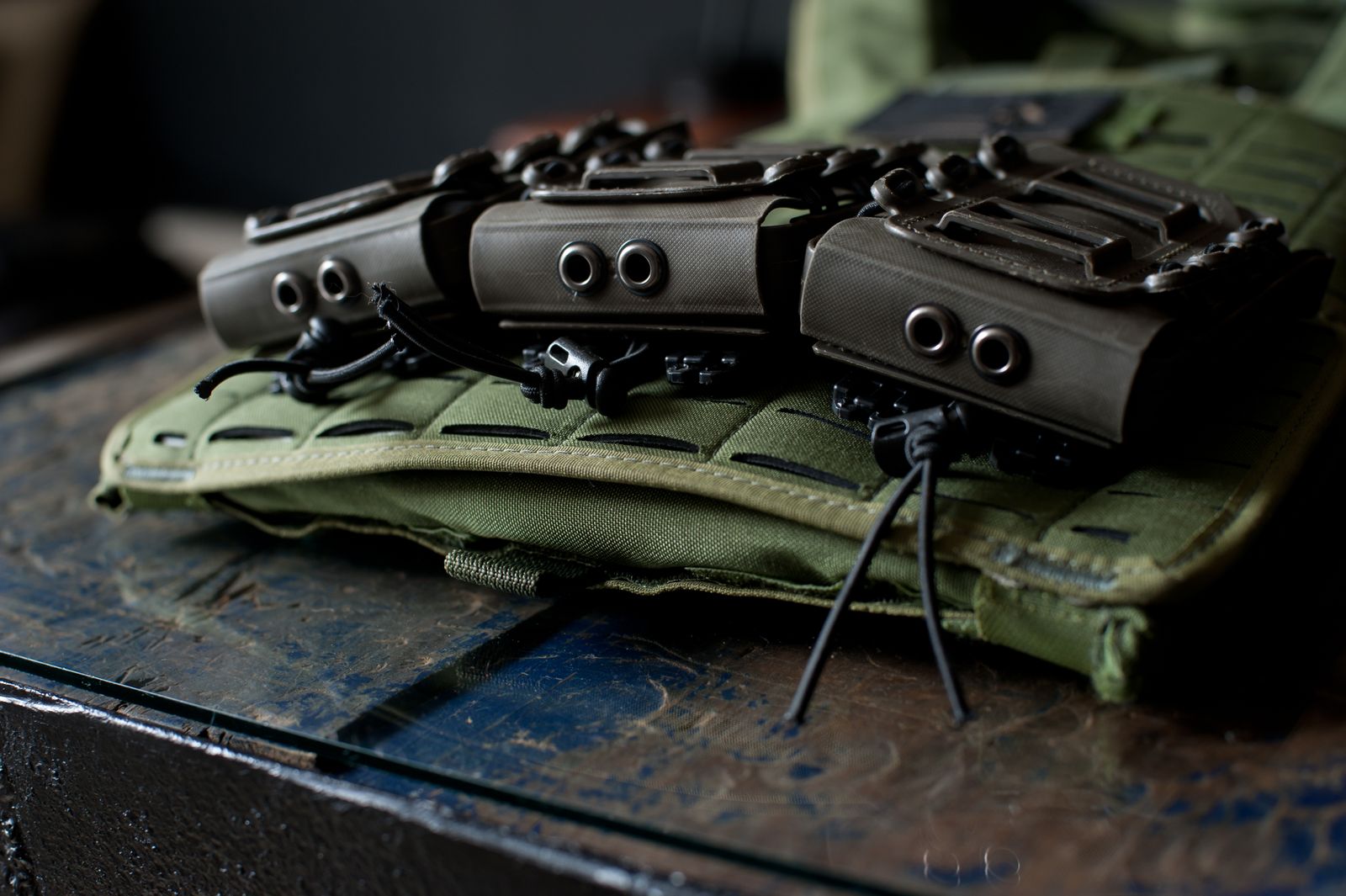
The previous version said: "Standard rows are 1 inch tall with 1.5-inch spacing between attachment points." That sentence takes two measurements that sit on perpendicular axes and presents them as one dimension. It is the kind of error that survives because it is copied.
| Dimension | Value | What it measures |
|---|---|---|
| Webbing width | 1 inch (25 mm) | The width of the webbing itself. Not a "row height" |
| Vertical gap between rows | 1 inch (25 mm) | The bare panel showing between one row and the next, giving roughly a 2-inch row pitch |
| Horizontal stitch interval | 1.5 inches (38 mm) | How often the webbing is sewn back down to the panel along its length. This is what creates the channels a pouch strap weaves through |
The 1-inch and 1.5-inch figures run at right angles to each other and are not interchangeable. If a supplier quotes you "1.5-inch spacing" for rows, either they have copied the same error or their grid will not accept standard pouches.
The larger finding, which changes how you should specify it. We could not find a military standard that defines PALS geometry. We went looking for one specifically so we could cite it, and it is not in the public record:
- The US Army's own PALS patent, US 5,724,707 (granted 1998, expired 2016), gives the webbing width — "one inch texture nylon webbing" — and then deliberately declines to give a number for the spacing, saying only that it "should be of sufficient dimension to permit the placement therebetween of another series of webbings".
- The Department of Defense purchase description for MOLLE, CO-PD-02-02N, specifies materials in exhaustive detail and contains no dimensional requirement for row spacing or stitch interval at all. Dimensions are delegated to Natick engineering drawings, which are not publicly released.
- The MOLLE II operator's manual gives no grid dimensions either.
The 1 / 1 / 1.5 figures are best cited to granted commercial patents — US 9,521,897 and US 9,723,909 both recite them in near-identical language. That makes them a de facto industry convention with a documented lineage, not a government standard. Anyone claiming their webbing is built "to MIL-STD PALS" should be asked which document they mean, because we could not find one.
What to do instead of citing a standard: specify the three dimensions above explicitly on your tech pack, in writing, and check a sample with a ruler. The compatibility you actually care about is with the aftermarket, and the aftermarket is built to the convention, not to a specification.
"Mil-spec" designates nothing unless it names a document, a type and a class
The old version listed "Cordura Mil-Spec" as a fabric grade — "the version of Cordura that meets military specification standards". There is no such product. CORDURA is an ingredient brand owned by INVISTA, and INVISTA's published fabric family list — AFT, Ballistic, Classic, Combat Wool, Denim, HP, Lite, Naturalle, Nyco, TrueLock, UltraLite and others — contains no "Mil-Spec" tier. CORDURA does not weave fabric at all; in its own words, it "works with certified mill partners globally and supplies fibers". "Cordura Mil-Spec" is retailer shelf-labelling for CORDURA-branded nylon finished to a military specification.
The specification it is finished to is real, and it is the one to name.
| Component | Document | What it covers |
|---|---|---|
| Pack body fabric | MIL-DTL-32439B, Cloth, Duck, Textured Nylon | Type I = 1000 denier, II = 725, III = 500, IV = 330; Classes 1-4 by finish and weight. Contains no trade names |
| PALS webbing | A-A-55301 (commercial item description) | Type III is the 1-inch webbing, 1,000 lb minimum breaking strength. Replaced MIL-W-43668 for all federal agencies — a supplier still citing MIL-W-43668 is quoting a superseded document |
| Thread | A-A-59826A | Nylon thread. The MOLLE purchase description calls out Size F for lockstitch seaming and Size E for bartacks |
| Wider webbing | A-A-55301 Type VI; MIL-PRF-17337; MIL-W-4088 | Type VI is the 1.5-inch webbing; MIL-PRF-17337 covers 2 and 3 inch; MIL-W-4088 spans a wide range of widths |
| Hook and loop | A-A-55126 | Fastener tapes |
| Zippers | A-A-55634 | Slide interlocking fasteners |
Published through ASSIST, the Defense Logistics Agency's document service. A meaningful claim reads "1000D fabric to MIL-DTL-32439B Type I, Class 3" or "1-inch webbing to A-A-55301 Type III". The words "mil-spec" with no document, type or class designate nothing, and cost nothing to say.
The denier finding, which runs against everything this category says
The old version presented a fabric hierarchy: 1000D Cordura at the top, 1680D ballistic polyester as the cost-effective alternative, 500D and 600D for accents. Two problems.
The 1680D line was internally incoherent. It described 1680D as "slightly heavier than Cordura at the same denier" — 1680 and 1000 are not the same denier. More seriously, no military specification calls for 1680 denier in packs at all. 1680D ballistic is a commercial luggage fabric, historically ballistic nylon rather than polyester. Calling it a tactical standard is not supported by any document we could find.
And the deeper problem is the premise. Denier is a unit of linear mass density — the mass in grams of 9,000 metres of yarn. It describes how heavy the yarn is. It does not describe abrasion resistance, tear strength or durability, and the government's own specification demonstrates this in the plainest possible way.
| Type | Denier | Grab breaking strength, warp / fill | Taber abrasion minimum |
|---|---|---|---|
| Type I | 1000 | 500 lb / 300 lb | None specified |
| Type II | 725 | 450 lb / 280 lb | None specified |
| Type III | 500 | 275-360 lb / 200-270 lb | 500 cycles (class 3), 800 cycles (class 4) |
| Type IV | 330 | 200 lb / 155 lb | 700 cycles (class 3), 500 cycles (class 4) |
Breaking strength to ASTM D5034, tear to ASTM D1424 and D2261, abrasion to ASTM D3884 with an H-18 wheel under a 1,000 g load. If denier were the durability metric, the specification would set its abrasion floors on the heavy types. It sets them on four specific light classes instead. The specification gives no reason for that and we are not going to invent one for it; what matters is that the document plainly does not treat denier as the abrasion claim.
Note also what the specification controls that denier does not: weight, coating and finish. Type I Classes 3 and 4 are 11.0 to 12.0 oz/yd², water-repellent and back-coated. Type I Classes 1 and 2 are 8.5 to 9.5 oz and untreated. Both are "1000D". They are not the same fabric, and a quote that says only "1000D" has told you almost nothing.
A contradiction on our own site, stated rather than quietly fixed. Another Backper page says the tactical "sweet spot" is 600D to 900D. This page said the standard is 1000D and 1680D. Neither claim has a published basis, and 600D and 900D are not even types in the specification, which runs 1000 / 725 / 500 / 330. What is documented is what the US military actually buys: the MOLLE II purchase description specifies MIL-DTL-32439 Type I, Class 3 — 1000 denier, 11 to 12 oz, water-repellent, back-coated — for main pack bodies, and Type III Class 3 (500 denier) for lighter components. The USMC FILBE purchase description specifies the same two weights, citing the predecessor Natick document GL/PD 10-07 by the same type and class numbering. That is the sourceable answer, and it is narrower than either of our pages claimed.
What to ask for instead of a denier. Weight in oz/yd² or g/m². Grab breaking strength to ASTM D5034. Tear strength to ASTM D1424 or D2261. Coating and finish. And if abrasion genuinely matters, a Taber figure to ASTM D3884 with the wheel and load stated — noting that Taber cycles, Wyzenbeek double rubs and Martindale rubs are three different quantities from three different machines and cannot be converted between each other. We could find no published, method-controlled comparison of 1000D nylon against 1680D polyester anywhere. Every comparison in circulation is written by someone selling one of them, ourselves included.
Camouflage: the encumbered patterns are not the ones you think
The old version said pattern licensing "requires proper licensing from pattern owners" and left it there. The actual position is more interesting, and in one direction more dangerous.
| Pattern | Patent position | Trademark position | Practical exposure |
|---|---|---|---|
| MultiCam | Design patent D487,848 expired 2018 | MULTICAM registered (Reg. 4443275, 4737503), owned by Lineweight LLC, not Crye Precision | Lower than assumed. Crye licenses printers and raw-material producers; its own published position is that if you buy from a licensed source you may sew it into your product without a licence. Using the word on unlicensed cloth is the infringement |
| MARPAT | Design patent D491,372 expired 2018; utility patent 6,805,957 expired 2021 | MARPAT word marks registered; the apparel-class mark sits on the Supplemental Register | The real exposure is not the pattern name. The pattern embeds the Eagle, Globe and Anchor, which is the most actively enforced mark the USMC owns |
| Kryptek | Design patents D679,099, D685,999, D686,000 — all live, running to 2027 | About 33 trademark filings, live and dead | The sharpest risk on this list. A live design patent covers the pattern itself, and 35 U.S.C. § 289 exposes an infringer to total profits on the article — with no need for anyone to have used the word "Kryptek" |
| A-TACS | None located | A-TACS CAMO registered (Reg. 4403422), expressly covering camouflage-patterned fabrics | Trademark, and an unresolved copyright theory. Licence terms are not published |
| OCP / Scorpion W2 | US Army holds utility patents 9,062,938 and 9,074,849, live to 2034 | No registration located | Printed commercially by multiple mills and published as Style H in MIL-DTL-32439B. No licence is offered and none appears to be demanded — but it is not formally public domain |
USPTO records. Design patents run 14 years from grant; utility patents 20 years from filing. Trademarks renew indefinitely and are a separate, longer-lived exposure from patents.
The litigation record cuts against pattern owners. In Crye Precision v. Duro Textiles the Second Circuit — in a summary order, which carries no precedential weight — affirmed judgment against Crye across the board: no likelihood of confusion between MultiCam and Scorpion W2, and the non-compete barring products "similar to MULTICAM through color palette, pattern, arrangement or placement" was held unreasonable in scope and unenforceable, with the court refusing to narrow it because "these terms are the essence of the clause". In the follow-on case against Bennettsville Printing, Crye lost again on collateral estoppel, and a magistrate judge recommended an award of $367,880 in the defendant's legal fees under the contractual fee provision — reduced from the $707,159 sought, with Lanham Act fees refused as not exceptional.
The practical reading: trade dress claims over camouflage have a poor record; live design patents are the real weapon. Which inverts the usual advice. MultiCam, the pattern everyone asks about, is the one whose design patent has lapsed. Kryptek, which rarely comes up in a sourcing conversation, is covered until 2027 by a remedy that reaches your entire profit on the goods.
The attachment panel is more encumbered than the camouflage
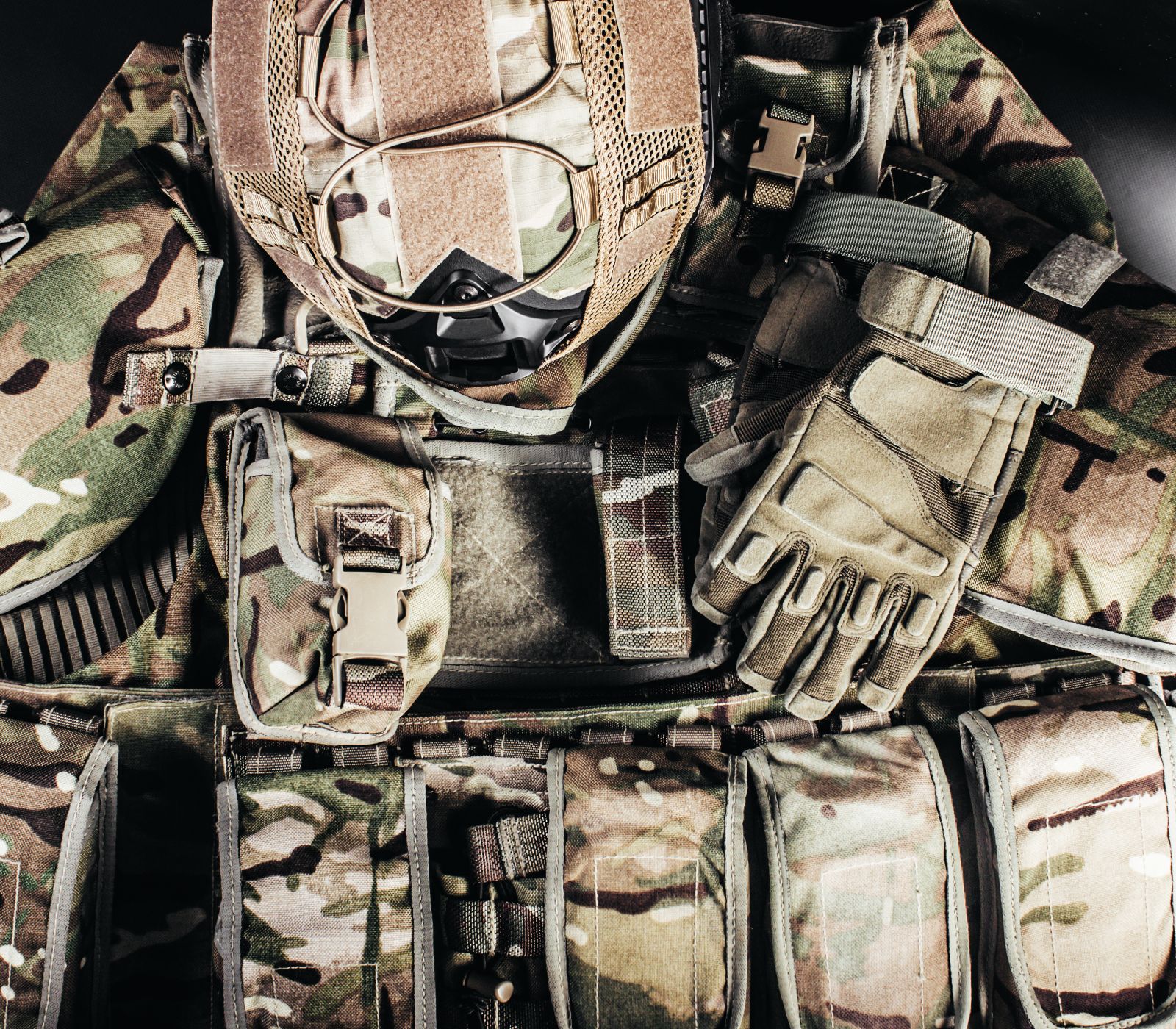
The old version warned that "some laser-cut systems are patented". That is right, and it is worth being specific, because this is a live estate with a public marking page.
| Patent | Holder | What it claims | Runs to |
|---|---|---|---|
| US 8,720,762 and continuations (9,295,319; 10,159,328 and others) | Blue Force Gear | Not laser cutting as such — unitary cut-and-fold construction: a single piece of material whose straps are "an integral part of the body portion", folded back on themselves. Laser cutting appears as an enabling method | June 2031 |
| US 11,540,617 | Point Blank Enterprises | The slot geometry itself — a cut with segments meeting at non-orthogonal angles with curved intersections, heat-sealed by the cutter to prevent fraying | 2039 |
| US 12,402,713 | Blue Force Gear | A piping-and-channel attachment method, granted September 2025 | 2043 |
Blue Force Gear publishes a virtual patent marking page under 35 U.S.C. § 287, which gives constructive notice. Patent infringement is strict liability, so marking does not defeat a defence — it preserves the holder's right to pre-suit damages and bears on whether infringement is found wilful. Note the 2025 patent is not on that marking page. Because the Blue Force Gear claims turn on construction method rather than on the laser, exposure depends on your panel geometry and how the piece is cut and folded, not on whether a laser was used.
What to do: get written IP indemnity from the supplier covering the attachment panel specifically, and treat "we make it for everyone" as the non-answer it is.
The rule that decides whether you can sell to a government at all
The old version mentioned "certain government contracts" once, in the context of fabric. That has it backwards. For an imported pack, the fabric specification is not the obstacle. The obstacle is the appropriations statute, and no specification cures it.
| Regime | What it does | A Chinese-made tactical pack |
|---|---|---|
|
Berry Amendment 10 U.S.C. § 4862, DFARS 252.225-7012 |
Prohibits DoD funds being used to procure covered items not grown, reprocessed, reused or produced in the United States. Covers "any item of individual equipment manufactured from or containing" synthetic fabric — DFARS pins this to product service code 8465, Individual Equipment, which is where packs and rucksacks sit | Barred outright above the $200,000 threshold. Not a preference — a prohibition, reaching the fibres and fabrics themselves. Cutting, kitting or relabelling does not cure it. There is no qualifying-country exception to Berry at all |
|
Trade Agreements Act FAR 25.4, clause 52.225-5 |
Requires delivery of US-made or designated-country end products. Applies to all GSA Multiple Award Schedule contracts regardless of order size | Barred — China is not a designated country. It appears on none of the four lists. But there is one door: a pack substantially transformed in the United States can qualify as a "US-made end product" even from imported components — which satisfies TAA and still fails Berry |
|
Buy American Act 41 U.S.C. ch. 83, FAR 25.1 |
A price preference, not a ban. Foreign offers are penalised by an evaluation factor — 50% on DoD acquisitions under DFARS 225.502; the FAR figures of 20% against a large-business domestic offer and 30% against a small business apply outside DoD | Permitted but penalised. Domestic content threshold is 65% in 2026, rising to 75% from 2029. Most commercially sold packs are COTS items, for which the content test is waived and only the "manufactured in the United States" prong bites |
|
1122 Program 10 U.S.C. § 281 |
Lets state and local agencies buy counter-drug, homeland security and emergency response equipment through DoD and GSA channels | The statute imposes no domestic-source rule. Berry attaches to DoD appropriated funds and 1122 purchases are made with state and local money, so it does not reach them — by the scope of the statute rather than by an express carve-out. In practice the goods still have to be on a GSA schedule, so the TAA gate blocks it anyway |
The $200,000 Berry small-purchase threshold was raised from $150,000 by DFARS Case 2024-D002, effective 1 October 2025 — the statute still reads $150,000, so a supplier quoting the old figure is reading the wrong document. Thresholds are inflation-adjusted every five years.
The compact version, and the sentence worth keeping: Berry is a wall, TAA is a wall with one door, Buy American is a toll booth. Anyone telling a wholesale buyer they can supply Chinese-made packs to the US military is wrong. Anyone telling them they cannot sell Chinese-made tactical packs commercially in the United States is also wrong — and that is the far more common error.
Two rules people expect to apply here, which do not
A tactical backpack is not ITAR-controlled. Category X of the US Munitions List covers personal protective equipment — body armour at NIJ Type IV or above, helmets at the same level, signature-management clothing — and does not mention packs, rucksacks or load-carrying equipment anywhere. Nor does it appear on the Commerce Control List: ECCN 1A613 lists armour plate, shelters, helmets and body armour — and, in a catch-all at 1A613.f, other personal protective equipment specially designed for military applications. A pack is not protective equipment, so the catch-all does not reach it either. A tactical backpack with no armour content is EAR99, subject only to embargo, entity-list and end-user screening. MOLLE webbing and a camouflage print control nothing.
The exception is real and worth stating: add a ballistic panel and the analysis changes completely. Armour below NIJ Type IV falls under ECCN 1A613.d and is licensable for export; Type IV and above is on the Munitions List. A "bulletproof backpack" is a different regulatory product from a backpack.
There is no US restriction on civilian camouflage. 18 U.S.C. § 702 restricts wearing the uniform of the armed forces; it is not an import or sale restriction, and no federal law restricts manufacturing, importing or selling goods in a camouflage pattern. The constraints are the ordinary patent and trademark ones set out above.
Export markets are a different matter, and one is an import ban. Several countries prohibit civilian camouflage. Most are wearing offences — Barbados, Saint Lucia, Antigua and Barbuda, Grenada, Zimbabwe, Ghana, and Uganda, where the maximum sentence on conviction is life imprisonment. Trinidad and Tobago is the one that stops a shipment: it is illegal to import camouflage-pattern material without approval from the Ministry of National Security. If you are selling into the Caribbean or West Africa, that is a market-access question to answer before the order, not after.
The restriction that actually bites on an imported pack
Not ITAR, not camouflage law. Forced labour, and duty.
Section 307 of the Tariff Act, 19 U.S.C. § 1307, prohibits entry of goods produced wholly or in part by forced labour. The Uyghur Forced Labor Prevention Act applies a rebuttable presumption to goods produced wholly or in part in Xinjiang, and cotton is one of the named high-priority enforcement sectors. "Wholly or in part" means third-country assembly does not clear it — a pack sewn in Vietnam from Xinjiang cotton is still caught. Rebutting the presumption requires clear and convincing evidence and full supply-chain traceability. Cotton canvas panels and cotton-blend webbing put a tactical pack directly in scope; all-synthetic construction reduces but does not eliminate the exposure.
On duty, a tactical pack classifies where every other backpack classifies. MOLLE webbing, camouflage and admin panels are not classification events. What moves the rate is the outer surface material — man-made fibres at 17.6% under HTSUS 4202.92.31, cotton at 6.3%, plastic sheeting at 20% — with 25% added on Chinese origin under Section 301 List 3, and a further 12.5% under the Section 301 forced-labour action effective 24 July 2026 unless your line falls within that action's exemption annexes, which we have not read line by line. We set that out in full, with the ruling record, in the team sports guide and the shipping and customs guide. Note one trap specific to this category: a 50/50 plastic-sheeting and textile shell falls to the 20% line by operation of GRI 3(c), so a heavy TPU or laminate face on a tactical pack is a duty decision as well as an aesthetic one.
The prices and minimums we published
We previously gave landed costs of $28 to $52 for a 25L daypack at 1,000 units and $52 to $95 for a three-day pack at 1,500 units, with minimums of 500 to 1,000 units per colourway semi-custom and 1,500 to 3,000 fully custom. No published source corroborates any of those figures, and we could not find one.
| Source | Figure | Why it is not a benchmark for you |
|---|---|---|
| DLA, MOLLE 4000 rucksack set, NSN 8465-01-673-3364 | $376.90 standard unit price | Berry-compliant US manufacture, delivered, with first-article testing and government quality assurance |
| GSA published schedule price list, Nimrod Pack Systems, contract GS-07F-0193X | $97.12 to $293.14 across the range | Same — US-made, delivered, schedule-priced |
| State cooperative contracts | No tactical daypacks priced | Michigan and Delaware tactical contracts list weapon cases and leather goods, not packs |
Government pack prices are a different cost basis from an Asian FOB or landed price and do not corroborate our ranges in either direction. Comparing $376.90 to $52 is comparing two unrelated things. The minimums we published have no published basis of any kind.
There is one route to a genuinely public landed number, and it is worth knowing: US Census and USITC trade data publish average unit values by tariff line and origin country for HTS 4202.92.3120. That gives a real, published landed value per unit that anyone can check. It does not separate tactical packs from other backpacks, so it is a floor on your knowledge rather than an answer — but it is public, and no supplier's price range is.
Sourcing a tactical programme with Backper
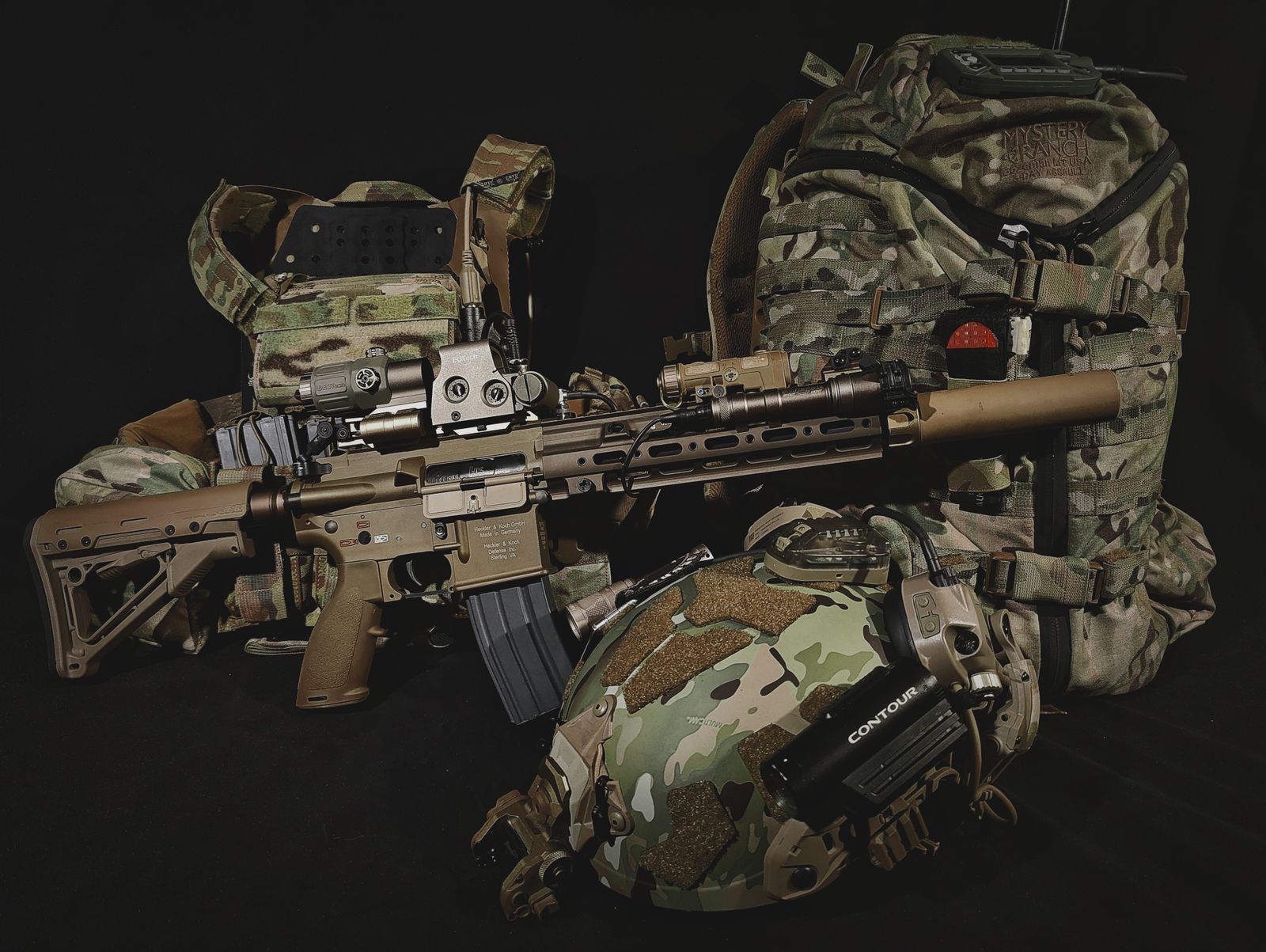
Applying this page's own tests to us:
| Test | Where we stand |
|---|---|
| PALS geometry | We published it wrongly until today. We build to the 1 inch / 1 inch / 1.5 inch convention and will state all three dimensions on a tech pack. Ask us to, and measure the sample |
| Fabric specification | We can source to MIL-DTL-32439 Type I Class 3 and Type III Class 3 and will state type and class. We do not hold mill certification in our own name — certification is the mill's, passed through with scope and expiry |
| Abrasion and strength data | Not held as standing test data. We can commission ASTM D5034 and D3884 testing per programme at your cost. Any supplier quoting you a denier as a durability figure, us included historically, is not answering the question |
| Berry Amendment | We cannot make you Berry-compliant. Our production is not US-based and no specification, finishing step or relabelling changes that. If your programme sells to DoD, we are the wrong supplier and you should be told that before you sample, not after |
| TAA and GSA schedules | Chinese-origin goods cannot go on a GSA schedule. US substantial transformation is a real route and one we do not offer |
| Camouflage licensing | We print to order and rely on the buyer to hold or clear the rights. We do not carry a MultiCam raw-material licence, and we will not knowingly print a live design-patented pattern. The Kryptek exposure above is a buyer risk that we would share |
| Attachment-panel IP | We do not currently offer written IP indemnity on laser-cut panel geometry. That is a gap, it is ours, and you should ask for indemnity from any supplier including us |
| Pricing and minimums | Our published figures were unsourced and are withdrawn. Current terms are 100 units per style branded and 50 for catalogue stock, self-reported and unaudited, with tactical builds quoted per specification rather than from a table |
Every one of these eight records something we cannot do, do not hold, or got wrong. A page whose author passes all of its own tests is a sales page with headings.
If you are scoping a tactical programme, send the silhouette, the fabric type and class you want, the pattern and its licensing position, and the destination market. You can see current silhouettes in the tactical collection and stock-priced items in bulk deals, and you can ask for a quote here.
Related reading. For decoration methods and what each setup charge buys, see logo printing methods. For the duty stack and the ruling record in full, see the team sports guide. For quote line items, how to read a wholesale backpack quote, and for freight and customs, shipping, freight and customs.
What we could not verify
- No military standard defines PALS geometry. Stated as "we identified none" rather than "none exists" — the Natick engineering drawings referenced by the MOLLE purchase description are not publicly released, and one of them may well contain the grid. The 1 / 1 / 1.5 figures are cited to granted commercial patents whose wording is near-identical across two unrelated assignees, which makes them a documented convention with a common lineage rather than independent confirmations.
- The vertical row figure is a gap, not a pitch. Every accessible source says rows are "spaced 1 inch apart". We could not obtain a dimensioned drawing confirming a centre-to-centre figure, so we have not printed one.
- The MIL-DTL-32439B numeric table was read by automated extraction of a mirrored PDF rather than from the DLA-hosted copy. The structure and the abrasion finding are solid; check individual figures against ASSIST before they enter a purchase specification.
- No independent abrasion comparison of pack fabrics exists in the public domain. Not for 1000D nylon against 1680D polyester, not for anything else in this category. Every comparison we found was published by a party selling one of the fabrics.
- No published benchmark for tactical pack pricing or minimums. Government contract prices are published but rest on a different cost basis. Our own withdrawn figures were quote-derived, and so is every range you will read elsewhere.
- Kryptek and A-TACS trademark registration numbers were not fully retrieved, and we did not exhaustively search for design patents held by Digital Concealment Systems. Absence of a finding is not absence of a right.
- We found no USPTO registration for the MARPAT pattern itself, only word marks — a null result, not proof that none exists. Likewise no registration located for "Operational Camouflage Pattern" or "Scorpion W2".
- We found no Army licensing programme and no enforcement action on the Scorpion W2 patents, and no USMC enforcement specifically over MARPAT against a manufacturer. That is why we have written OCP as "no licence offered, none apparently demanded, patents live to 2034" rather than as freely usable. Do not read our null result as permission.
- Crye v. Duro issued as a summary order, which means it has no precedential effect — worth weighing before leaning on it, as we partly do. We cite it by docket number and date rather than by reporter.
- The current UFLPA Entity List count is unconfirmed, and we did not verify ECCN 1A613's current text against the live CFR — our reading is from the promulgating rule. A formal classification request is the safe route for anyone shipping armour-adjacent product.
- Our own status is self-reported. Everything in the table above is what we know about ourselves today, and every line can be evidenced on request.
Sources
PALS and MOLLE. US Patent 5,724,707, "Interlock attaching strap system", assignee US Department of the Army, granted 10 March 1998, expired 2016. Department of Defense Purchase Description CO-PD-02-02N, Modular Lightweight Load-Carrying Equipment, 24 September 2019. TM 10-8465-236-10, Operator's Manual for MOLLE II, 20 June 2013. US Patents 9,521,897 B2 (Fechheimer Brothers) and 9,723,909 B2 (5.11 Inc.) for the recited grid geometry.
Specifications. MIL-DTL-32439B, Cloth, Duck, Textured Nylon (base revision 6 October 2020, superseding MIL-DTL-32439A of 2017); A-A-55301A, Webbing, Textile, Textured or Multifilament Nylon; A-A-59826A, Thread, Nylon; MIL-PRF-17337; MIL-W-4088; MIL-DTL-5038; A-A-55126; A-A-55634 — all distributed through ASSIST, Defense Logistics Agency Document Services. USMC Purchase Description, Family of Improved Load Bearing Equipment, 10 May 2011. INVISTA CORDURA published fabric family and brand FAQ. ASTM D5034, D1424, D2261, D3884, D4157; ISO 12947-2; ISO 1144; ASTM D861.
Intellectual property. USPTO registrations 4443275 and 4737503 (MULTICAM, Lineweight LLC); design patent D487,848. USPTO registrations 4915837 and 6634904 (MARPAT); patents 6,805,957 and D491,372, Department of the Navy. Kryptek design patents D679,099, D685,999, D686,000. USPTO registration 4403422 (A-TACS CAMO). US Patents 9,062,938 and 9,074,849, Department of the Army. Blue Force Gear virtual patent marking page under 35 U.S.C. § 287; US Patents 8,720,762, 9,295,319, 10,159,328, 12,402,713; Point Blank Enterprises US Patent 11,540,617. Crye Precision LLC v. Duro Textiles LLC, No. 16-1333-cv (2d Cir. 3 May 2017), affirming 112 F. Supp. 3d 69 (S.D.N.Y. 2015); Crye Precision LLC v. Bennettsville Printing, No. 15-CV-221 (E.D.N.Y. 13 August 2019). DoDI 5535.12, DoD Branding and Trademark Licensing Program, Change 2, 23 September 2025; Marine Corps Trademark Licensing Program.
Procurement and trade. 10 U.S.C. § 4862 (Berry Amendment, recodified from § 2533a); DFARS 225.7002-1, 225.7002-2 and clause 252.225-7012; DFARS Case 2024-D002, threshold change effective 1 October 2025. FAR 25.4 and clause 52.225-5 (Trade Agreements); FAR 25.003 definition of US-made end product. 41 U.S.C. ch. 83 and FAR 25.101; FAR Case 2021-008, 87 FR 12780, 7 March 2022. 10 U.S.C. § 281 (1122 Program). 22 C.F.R. § 121.1 Category X; ECCN 1A613, 15 C.F.R. Part 774. 19 U.S.C. § 1307; Uyghur Forced Labor Prevention Act, Pub. L. 117-78. 19 U.S.C. § 1304 and 19 C.F.R. Part 134. 18 U.S.C. § 702. US State Department and UK FCDO travel guidance on civilian camouflage restrictions. USITC Harmonized Tariff Schedule 4202.92.
Rewritten 10 August 2026. This page previously misstated the PALS specification, described a Cordura grade that does not exist, presented denier as a durability measure against the plain text of the specification it was invoking, and published prices and minimums with no source. It also omitted the Berry Amendment, which is the rule that decides whether an imported pack can be sold to a government at all. Corrections have been made in the open rather than quietly deleted. Patent expiry dates and duty rates both move — re-check anything here before it goes into a purchase specification, a customs entry or a licensing decision.
Tags:
Previous
Custom Hiking and Outdoor Backpacks Wholesale: Specs, Materials, and Sourcing for Outdoor Brands
Next
Wholesale Custom Travel Backpacks: Carry-On Compliance and the Spec That Actually Clears Every Airline
Related articles


-
Jul 16 2026