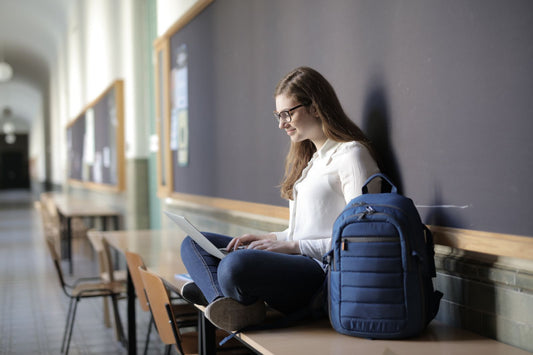


If you finish most days with a dull ache between your shoulder blades, the problem usually isn't your posture — it's your backpack. An ergonomic backpack isn't a marketing buzzword. It's a specific set of engineering choices that move weight off your spine and shoulders and onto your hips and core, where your body is actually built to carry load.
What "ergonomic" actually means in a backpack
A backpack is ergonomic when it does three things: (1) keeps the center of gravity close to your spine, (2) distributes weight across multiple contact points instead of two shoulder straps, and (3) flexes with your body as you walk, bike, or climb stairs.
The 7 features of a truly ergonomic backpack
1. S-curved, padded shoulder straps
Straight straps press into the trapezius and pinch nerves over hours of wear. S-curved straps follow the natural slope of your collarbone, distributing pressure across a wider area. Look for 3–4 inches of width and at least 8mm of memory foam padding.
2. A padded sternum strap
The chest clip isn't just for hikers. It pulls the shoulder straps inward, redistributing 15–20% of the load off your shoulders and onto your chest and upper back — muscle groups built for sustained load.
3. A padded hip belt (for loads over 7kg / 15lb)
This is the single biggest difference between a comfortable backpack and an uncomfortable one. A proper hip belt transfers 60–80% of the pack's weight onto your iliac crest (top of your hip bones) — the strongest weight-bearing point in your body. If you're carrying a laptop + books + gym clothes, you need this.
4. A ventilated back panel
Mesh-covered foam channels (or a suspended trampoline mesh on hiking packs) let air flow between your back and the pack. Without it, you'll have a sweat patch by 9am and the pack will slide around as you walk.
5. Adjustable torso length
If you're under 5'5" or over 6'2", a fixed-back pack will sit wrong on your spine. Premium packs let you slide the harness up or down to match your torso length — measured from the C7 vertebra (the bump at the base of your neck) to your iliac crest.
6. Load-lifter straps
Those small angled straps at the top of the shoulder harness pull the top of the pack closer to your back, preventing it from sagging backward and yanking on your shoulders. Essential for loads over 5kg.
7. A rigid frame or framesheet
A floppy bag transfers every bounce directly into your spine. A framesheet (a sheet of polyethylene or aluminum stays) keeps the pack rigid against your back so the load moves with you, not against you.
How to size an ergonomic backpack
Stand straight. Measure from your C7 vertebra (the bony bump at the base of your neck) down to the top of your hip bones. That's your torso length. Most adult packs fit a 16–20 inch torso. Short torsos under 16" need a small or women's-specific pack; tall torsos over 20" need a large frame.
Best ergonomic backpacks by use case
- Daily commute (laptop + lunch): 18–22L, padded laptop sleeve, sternum strap, ventilated back panel. Hip belt optional.
- School/college (textbooks + laptop): 22–28L, padded sternum strap, framesheet, hip belt for loads over 7kg.
- Day hiking (food, water, layers): 22–35L, full padded hip belt, load-lifter straps, ventilated mesh back.
- Multi-day travel (15–20kg): 50–70L, adjustable torso, structured hip belt, internal frame.
Common posture mistakes that no backpack can fix
- Carrying it on one shoulder. Even the best ergonomic design fails if you sling it. Use both straps.
- Letting the pack sag below your hips. The bottom of the pack should sit at your waistline, not your butt.
- Loading heavy items at the bottom. Put dense items (books, laptop) close to your spine and high up. Light, bulky items (jacket) go low and away from your back.
- Overpacking. A backpack should weigh no more than 10–15% of your body weight for daily use.
When a backpack causes back pain anyway
If you've checked all the boxes and still hurt: (1) you may be carrying too much weight, (2) the pack may not be sized to your torso, or (3) you may have an underlying postural issue worth seeing a physiotherapist about. A truly ergonomic pack will be comfortable for 8+ hours at typical commute loads (5–9kg). If yours isn't, something's wrong.
What to look for in a custom ergonomic backpack
If you're building a custom or branded backpack run, the ergonomic spec should be non-negotiable: S-curved straps, sternum strap standard, framesheet for any pack over 20L, and adjustable torso on anything over 30L. These add $0.40–$2.00/unit to manufacturing cost but cut return rates dramatically. Backper's Custom & Branded line includes these as default on all builds 22L+.
The bottom line
A truly ergonomic backpack moves load off your shoulders, off your spine, and onto your hips. The features that get you there — S-curved straps, sternum strap, hip belt, framesheet, ventilated panel — are not optional extras. They're the difference between finishing your day comfortable and finishing it with a tension headache.
Related reading: If ergonomics matter because of chronic pain specifically, see Best Backpacks for People with Back Pain. For load-carrying on the trail, see our Day Hiking Backpack Guide.
Tags:
Previous
What's the Best Backpack for Daily Commuting? A Complete 2026 Guide
Next
How to Choose a Backpack: The Ultimate 2026 Buying Guide
Related articles


-
Jul 16 2026