

Rewritten 9 August 2026 and updated 10 August with our answer to the factory-ownership question — this guide has been rebuilt with sourced references, corrections to its compliance section, and a note on what we could not verify.
A note on who wrote this. Backper sells wholesale custom backpacks. A supplier-selection checklist published by a supplier has an obvious conflict, and the honest way to handle it is to say so at the top rather than at the bottom. We have rewritten this guide to name the sources behind every number, to remove the ones we could not support, and to apply the checklist to ourselves where it lands on us. Where a test would count against us, that is noted in the text.
Choosing who makes your bags is the decision the rest of the project depends on. Get it wrong and no amount of specification discipline downstream recovers it: the samples arrive late, the certificates belong to somebody else, and the first thing you learn about your factory is its address, from a customs broker, after the goods have shipped.
What follows is a checklist. It is more useful than the version we published before, because the numbers in that version had no sources behind them and several of them were wrong. We have kept the structure and replaced the substance.
Start With the Right Shortlist

Approach several manufacturers rather than one, and approach them with the same written brief so the quotes are comparable.
We previously said three to five was "the sweet spot". There is no evidence for that number and we have removed it. It is also a number that happens to serve us: a shorter shortlist means fewer competing quotes, and a supplier recommending you gather fewer quotes should be read with that in mind. Use as many as you can properly evaluate.
Do look for relevant experience in your category. A factory that builds commuter packs every week has the tooling, the fabric already on the shelf and the pattern library to sample faster than one starting from a photograph. That is a reasonable inference from how bag manufacturing works, not a measured effect, and we have not seen it quantified.
Category is worth being concrete about when you write the brief, because "backpack" covers products with very little in common: business, school, hiking and outdoor, travel, tactical and kids packs differ in pattern, hardware and testing burden. Name yours in the first email.
The 10-Point Supplier Checklist
1. Pre-production samples
Ask for a pre-production sample made to your specification before any bulk runs, and expect that most suppliers will charge for it.
We used to write that a free sample is "almost always a low-effort generic bag with your logo slapped on". That is an assertion about competitors we cannot support, and it conveniently justifies our own paid-sample policy. We should be straight that we have no evidence-based replacement for it either. Paid sampling is our policy and it is common in the trade; the arguments for it — that paying gets you your pattern rather than a shelf item, that it gives you standing to reject — are a supplier's arguments, not a measured finding, and you should weigh them as such.
What does not depend on who is right about that: ask what the sample fee covers, whether it is credited against the first production order, and how many revision rounds are included before the fee resets. Those three answers tell you more than the price does, and they work the same way whether the sample is free or not.
2. Manufacturing transparency
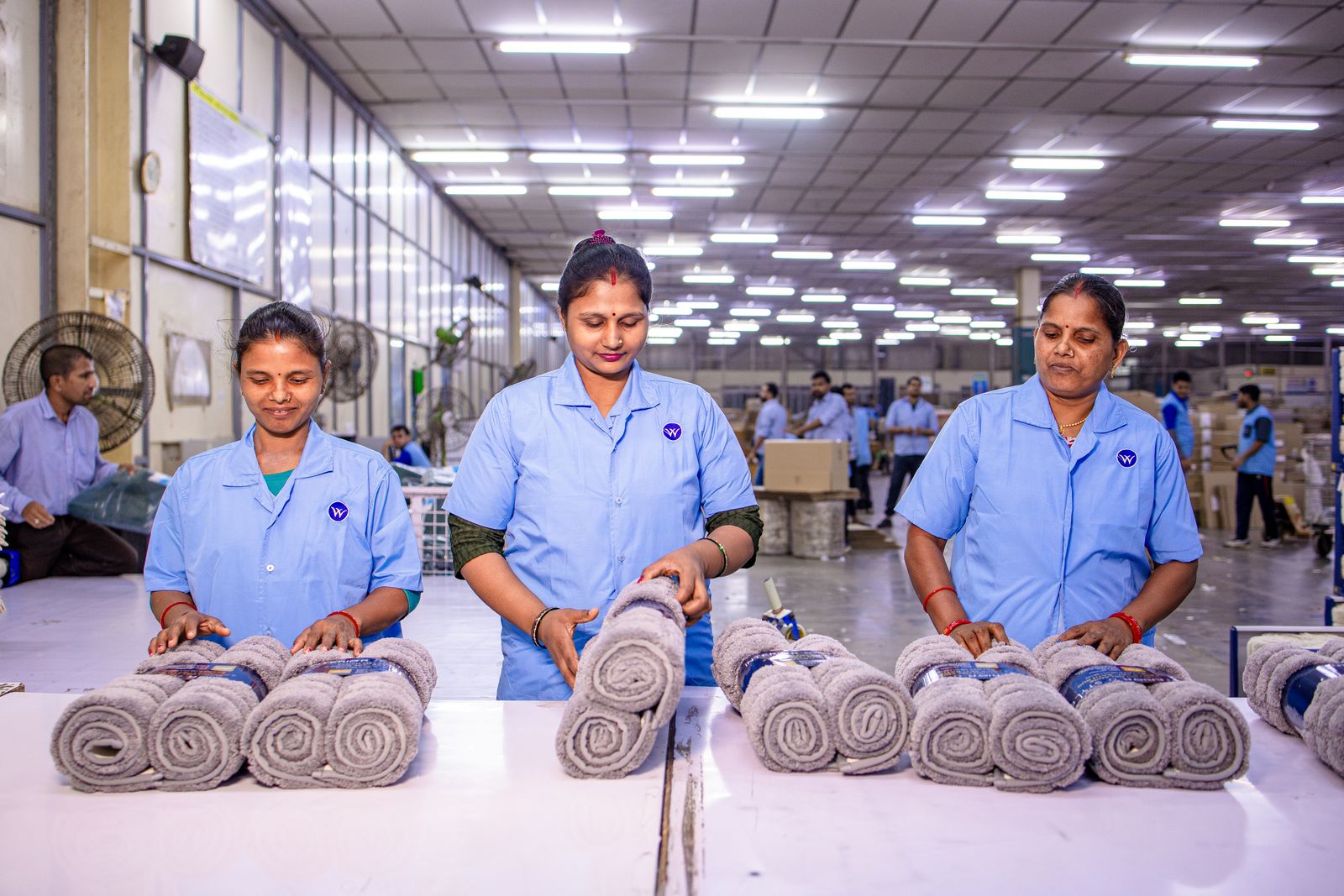
Ask for the factory's name, its full address, and photographs or video of the line running your kind of product. Then ask the question that actually matters and that most buyers skip: are you the factory, or are you arranging production somewhere else?
This is the test that lands on us, and here is our answer. We are not the factory. Backper is the wholesale side of BANGE — same company, same warehouse — and production runs at partner factories in the Guangzhou area of southern China that we do not own. Our factory page describes "the workshops that cut and stitch our bags", and the previous version of this page said "at Backper we manufacture wholesale custom backpacks" — both of which describe where production happens rather than who owns it. That was the looseness this checklist item exists to catch, and it was ours.
Sourcing from partners rather than owning a line is an ordinary arrangement with real advantages for a buyer: more silhouettes, and faster switching between them than a single plant can offer. It is not the same thing as owning the factory, and it means you should ask us the follow-up you would ask anyone: which specific plant will run my order? Ask for it in writing before the deposit rather than taking a verb for an answer.
Reluctance to answer is worth noticing. It is not proof of anything — some factories are genuinely bound by confidentiality to other customers — but the answer should exist and should be consistent across the documents you are later sent.
3. Compliance and certifications
The previous version of this section listed nine items in one sentence, mapped five of them to markets, and implied the other four worked the same way. Two of the five mappings were wrong, and each of the four voluntary schemes works differently from the way the sentence suggested. This is the part of the guide we most needed to rebuild.
3a. What actually applies to a children's backpack
| Market | What applies | Instrument |
|---|---|---|
| United States | Total lead 100 ppm in accessible parts; lead in surface coating 90 ppm; permanent tracking label on product and packaging; a Children's Product Certificate issued by the US importer, based on testing at a CPSC-accepted lab | 15 U.S.C. 1278a; 16 CFR 1303; 16 CFR 1107 and 1112; 16 CFR 1110; 15 U.S.C. 2063(a)(5). No federal flammability test applies: 16 CFR 1610 reaches wearing apparel only |
| ASTM F963 does not apply to a plain school backpack | 16 CFR 1250; F963 scope | |
| Canada | Lead 90 mg/kg for children under 14, and a textile flammability test that does reach bags: flame spread must be slower than 3.5 seconds, or 4 seconds for a raised-fibre surface such as a brushed or fleece-backed panel. Phthalate limits attach only to toys and child care articles, on the same logic as the US rule, so they do not reach a plain school backpack | CCPSA; SOR/2018-83; SOR/2016-194 |
| European Union | No registration for finished bags. The EU importer, not the factory, must communicate any candidate-list substance above 0.1% by weight of the component part, notify ECHA above one tonne a year unless exposure can be excluded, and submit an SCIP entry. Separately, an economic operator established in the EU must be named, with manufacturer and importer identification and a type or batch identifier on the product or its packaging | REACH Articles 7(2) and 33; Waste Framework Directive; Regulation (EU) 2023/988 |
| United Kingdom | UK REACH is a separate regime with its own candidate list, administered by HSE. Northern Ireland stays under EU REACH | UK REACH |
| Mexico | A permanent Spanish-language label under the general commercial information norm. The textile-specific norm sets the content — fibre composition, country of origin, care symbols, importer identity — where the product falls in its scope, which for backpacks is not settled | NOM-050-SCFI-2004; NOM-004-SE-2021 |
The EU candidate list stood at 253 substances on 4 February 2026 and grows roughly twice a year; UK REACH received its first substantive post-Brexit expansion on 15 June 2026, adding 15. The 0.1% threshold is assessed per article — a zip pull or a coated webbing is measured on its own weight, not diluted across the whole bag.
Two corrections, and one clarification we should have made the first time. First, ASTM F963 is the toy safety standard, and its scope covers objects designed or marketed as playthings. A school backpack is a children's product but not a toy, so F963 does not apply to it — though a plush character bag sold as a plaything can be pulled in. Second, the CPSC is a United States agency; grouping it with Health Canada as "North America" hides the fact that Canada uses a lower lead limit, a wider age band and a flammability test the US does not apply to bags. Third, phthalate limits in the US attach to toys and child care articles, not to every children's product — buyers often require the testing contractually, which is a different thing from the law requiring it.
3b. The voluntary schemes, and who is allowed to use them
This is the trap. Every scheme in the table below is held by a specific party at a specific point in the chain, and in three of the five that party cannot be you. A certificate held by your fabric mill does not give you the right to put a mark on your bag.
| Scheme | Who holds it | Can it appear on your bag? |
|---|---|---|
| OEKO-TEX STANDARD 100 | The party certifying each article, at any processing stage | Only with a certificate issued for the finished bag. Under the modular system, component certificates waive re-testing but do not license a mark on the finished article. Confirm the current wording with the certifying institute before you write it into a contract |
| bluesign | Fabrics and trims are bluesign APPROVED; the finished good is bluesign PRODUCT | Only if you are a system partner. A bluesign PRODUCT in the Equipment category — where bluesign puts backpacks — needs at least 90% of the fabric and at least 20% of the accessories approved, rising to 40% of accessories for new products placed on the market from 2027; and the brand must hold system partner status |
| Global Recycled Standard | Sites hold scope certificates; shipments carry transaction certificates | Only with your own scope certificate and prior approval of the artwork by your certification body, under the current claims policy |
| SA8000 | The facility. It is a genuine certification of a site, never of a product or a brand | No. The honest claim is "made in an SA8000-certified facility" |
| amfori BSCI | The supplier's production site, as an audit | No — and it is not a certification at all. amfori states this plainly. It is a social audit programme producing a rated report |
Note the naming, because getting it wrong signals to a supplier that you have not read the scheme: it is OEKO-TEX STANDARD 100 — not "OEKO-TEX 100", and no longer the older "STANDARD 100 by OEKO-TEX" — and amfori BSCI, not "BSCI". We used both legacy forms in the previous version.
What to ask for instead of a logo. Request the certificate itself, in the certificate holder's name, with its number and expiry, and check it on the scheme's own public database. Then ask the question that catches most substitutions: does the scope of that certificate cover the specific article you are buying? A mill's certificate covering a 600D polyester does not cover the webbing, the lining or the finished bag.
4. Clear MOQs and pricing tiers
Ask for the minimum order quantity, the price at each volume break, and what is excluded. The exclusions are where the surprises live: embroidery or screen setup charges, colour-matching fees, a sample fee that turns out not to be credited, and per-colour print charges that multiply on a four-colour logo.
We previously said concrete numbers should arrive "within 24 hours". We have no basis for that as an industry benchmark and have dropped it as a rule. As a practical matter, a supplier who has to go away and ask someone else for your pricing is telling you something about where the production sits.
Our own minimum, since we are asking others to publish theirs: 100 units per style branded, 50 for catalogue stock. Several of our guides quoted a 300 to 500 range in the body text while the FAQ said 100 and 50; the lower figures are the commitment, and those guides have since been corrected.
And note what that disclosure does not cover. This section asks a supplier for three things — the minimum, the price at each volume break, and the exclusions. Our volume breaks are published in our site FAQ, running from 15% at 50 units to 29% at 1,000 or more. Our surcharge schedule is not published — ask for it in writing, and hold us to the same standard as everyone else on your list.
5. Lead time discipline
Ask for a lead time as a range with the assumptions attached: from sample approval or from deposit, whether it includes Chinese New Year, what happens if a fabric is out of stock, and what the air-freight fallback costs.
The previous version quoted 45 to 55 days from sample approval. We looked for a published basis for that and there is none. Every figure we could find is a bag factory quoting its own capability on its own website, and they disagree with each other. Treat any lead time — ours included — as a commercial promise rather than an industry norm, and write the consequence of missing it into the purchase order.
6. Material sourcing and traceability
Specify hardware by brand and item code, or accept that you will get whatever is in the bin. Named zipper and buckle makers are usually quoted higher than unbranded equivalents and are easier to specify and replace consistently across reorders; whether they last longer in your application is a question we have not seen tested independently, and we are not going to assert it.
Denier is the specification most often misread here. It is a measure of yarn weight, not of fabric weight or strength: two fabrics at the same denier can differ substantially in grams per square metre depending on weave density and coating. We have not found a published dataset quantifying that spread, so we are not going to put a multiple on it. Specify fibre, denier, weave, gsm with a tolerance, and coating type and weight, and do not let denier stand in for any of them.
Then ask the traceability question properly, because this section is named for it. Ask whether the supplier holds material certificates per lot rather than one certificate on file from two years ago, and ask to see the one covering the lot your order will be cut from. For recycled or certified content, the document you want is the transaction certificate, not the scope certificate: a scope certificate says a site is certified, a transaction certificate says this shipment came through that certified chain. Without one, "recycled" is a description of an intention rather than a claim you can defend to a retailer or a regulator.
This paragraph is restored, not new. The previous version of this section said essentially the same thing — material certificates per lot, and a certificate tying the lot to the certified chain — and it was the best-sourced advice on the old page. We dropped it in the first pass of this rewrite while removing the unsupported material around it. Cutting the one paragraph that shifts document burden onto the supplier, in a supplier's article, is the exact fault this rewrite exists to correct, so it is back with the reasoning shown.
7. Reorder flexibility
Ask what the reorder minimum is, and how quickly a bestseller can be replenished. Then ask the expensive version of the question: are your pattern and tooling held between orders, and is any custom fabric or hardware held with them — for how long, and who carries the cost of holding it? Pattern and tooling are cheap for a supplier to keep. Fabric and trim inventory is working capital tied up on your behalf, which is why it is the half of the question that gets quietly dropped, including from the first draft of this rewrite.
A programme that is easy to start and hard to repeat is a trap that only becomes visible on the second order.
8. Payment terms and protection
The commonly quoted structure is 30% deposit with the balance before shipment. We previously called it "the standard". It is common, but no trade body or platform publishes data on how prevalent it is, and we could not find a survey that measures it — the sources are sourcing agencies and seller blogs. Describe it as the usual opening position, not as a rule you can hold someone to.
What is worth insisting on, regardless of the split: pay by bank transfer to a corporate account whose name matches the business registration you were given, never to a personal account or a third-party name; and get the inspection point written down, so that "before shipment" means after a defined quality check rather than before one.
Two further protections, both of which cost the supplier something and are therefore worth naming here. On a first order with a supplier you have not used before, an escrow or trade-assurance arrangement holds the balance until agreed conditions are met, and it is a reasonable thing to ask for precisely because the supplier carries the risk of your default rather than the other way round. And after a first project has completed cleanly, net 30 or net 60 terms are a normal thing to negotiate — the deposit-and-balance structure is an opening position for strangers, not a permanent state. We cannot tell you how often either is granted, because nobody publishes that, but both are asks a buyer is entitled to make.
9. Communication quality
Judge the response you get to a hard question, not the speed of the reply to an easy one. Ask something that requires the supplier to say no — a fabric that is out of stock, a deadline that is too tight, a certificate they do not hold. How they handle that is the closest thing you will get to a preview of how a production problem gets reported. Watch whether questions come back answered specifically or answered with a template — a copy-paste reply to a specific question is a non-answer with a fast timestamp on it.
A pattern of slow or missed replies during quoting is a real signal, and it belongs here rather than on the walk-away list. On its own it is not disqualifying — time zones, holidays and a busy line all produce it — but it compounds, and it is the phase in which a supplier is trying hardest. Log it rather than judge it in the moment: how many of your questions were answered on the first pass, and how many needed chasing.
10. References and reviews
Ask for references from buyers in your segment and at your volume, and ask them a specific question rather than a general one: what went wrong, and what happened next. Every supplier has a project that went wrong. The ones worth working with can describe theirs.
Then do the part the supplier does not control. Search the company name independently — trade forums, LinkedIn, trade-show recaps, and the dispute records of any platform it sells through — because a reference list is a curated sample and independent search is not. This was in the previous version of the guide, it costs us nothing to keep, and a supplier who quietly dropped it from a vetting checklist would be worth asking about.
Red Flags That Should Disqualify a Supplier
- Bank details that do not match the registered business name, or a request to pay a personal or third-party account. This is the one on the list that is close to dispositive.
- Certificates that cannot be produced, are expired, or are in someone else's name when presented as the supplier's own.
- A factory address that differs between documents, or that cannot be given at all.
- Refusal to make a pre-production sample and a push to go straight to bulk from photographs.
- Pressure on deposits or production slots framed as scarcity.
We have removed two red flags from this list, and you should know which and why.
One was self-serving. The previous version told you to walk away from "quotes that are dramatically lower than the rest of your shortlist with no clear explanation". Coming from a supplier, that is an instruction to be suspicious of anyone who undercuts us, and it gives no threshold for what "dramatically" means and no evidence that cheap quotes correlate with bad outcomes. A much lower quote is a reason to ask what is different — a lighter fabric, unbranded hardware, a lower inspection standard, or simply a lower margin — and every one of those has an answer you can check on the specification. Investigate it. Do not assume it.
The other was "a pattern of poor or delayed responses during the quoting phase", and our reason for demoting it is weaker. It is not disqualifying on its own — time zones, holidays and a busy line all produce it — so it belongs in the judgement section rather than the walk-away list, and it is now written out in full at point 9 rather than dropped. We are flagging the move because it is also the criterion our own self-assessment below comes closest to failing: we publish a one-business-day aim and no measurement against it. Demoting a test you would score badly on is a move you should be sceptical of, from us as much as anyone.
Questions to Ask on Your First Supplier Call

- Are you the factory, or are you arranging production elsewhere? If elsewhere, which plant will run my order?
- What proportion of your output is custom rather than stock, and what is your monthly capacity in my silhouette?
- Which certificates do you hold in your own name, and which belong to your mills? Can I see them, with scope and expiry?
- What is your inspection standard before shipment, at what AQL and what inspection level, and who performs it?
- What happens if the inspection fails — who pays for the rework, and does the shipment date move?
- If defects surface after delivery, what is your policy on rework or replacement, and who pays freight in both directions?
- When a problem appears mid-run, do you stop and notify me, or finish the run and tell me afterwards?
- Tell me about a recent project in my category that went wrong, and what you did about it.
The two questions about post-delivery defects and mid-run problems were on the original version of this list and were cut from the first draft of this rewrite. They are the two that put money on the supplier's side of the table, which is exactly why they are back.
The fourth question is the one that separates suppliers who have thought about quality from those who have a slide about it. If the answer is "we inspect everything", ask what sample size and what acceptance number — because a sampling plan has both, and an answer without them is not a plan.
How Backper Approaches Wholesale Custom Backpack Production
Applying the checklist above to ourselves, honestly:
| Test | Where we stand |
|---|---|
| 1. Paid pre-production sample | Yes, on every project — which answers the least useful of the three questions this guide says to ask. We have not published what the fee covers, whether it is credited against the first order, or how many revisions it includes. Ask for all three |
| 2. Are you the factory? | No. We source from partner factories in the Guangzhou area that we do not own; Backper and BANGE are the same company. Which specific plant runs your order is not published — ask for it in writing before the deposit |
| 3. Certificates in our own name | Limited. We do not hold OEKO-TEX STANDARD 100 certification for a finished bag, a GRS scope certificate, or bluesign system partner status. By the rule set out above, that means we cannot put those marks on a bag we sell you — a mill's certificate does not travel to the finished product. What we can do is pass the mill's certificate through with its number, scope and expiry so you can check it yourself, and tell you plainly what it does not cover |
| 4. Minimum order quantity | 100 units branded, 50 for catalogue stock, with automatic discounts from 15% at 50 units to 29% at 1,000 or more |
| 9. Communication | We aim to reply within one business day. We do not publish an achievement rate against that, and you should treat an unmeasured service claim from any supplier accordingly |
| Not on the checklist: packaging compliance registrations | Incomplete. We are working through registration in the European markets we ship to. If your programme depends on those being in place, ask us where we have got to before you order |
Of the ten checklist points, this table scores five. Two count against us outright, one is a service claim we cannot evidence, and one — whether we are the factory — we have now answered plainly rather than left hanging, having originally published it as an open question on this page. The last row is not a checklist item at all; it is here because it will affect a European programme and you would otherwise find out later.
And the five points we have not scored ourselves on are the expensive ones, so name them rather than let the table imply completeness. We have not published a lead time (5), what we hold between orders or who carries the cost of holding it (7), whether we will accept escrow on a first order or net terms after one (8), what documentation we pass through per lot (6), or references you can call (10). Those are all answerable, and none of them is answered on this page. Put them in the same email as the eight questions above and judge us on the reply.
If you want to test us on the rest of it, send the brief and put the eight questions above to us in writing. You can see what we make in our custom and branded collection and what is priced for immediate shipment in bulk deals, and you can ask for a quote here. We are deliberately not attaching a promise about how fast or how completely we will answer, a few lines after telling you to discount exactly that kind of claim. Judge the answers against the standard this guide sets.
Related reading. For a field guide to the kinds of factory you will actually be talking to, see The four factories you should know if you buy a backpack. Our own vetting framework is written up in What gets measured: the audit framework we wrote for our factories, which has since been through this review and carries a correction of its own.
What we could not verify
- This article has fewer numbers than our others, and that is the finding. Almost nothing about supplier selection is measured. There is no published dataset on typical lead times for custom bag production, none on how common the 30/70 payment split is, none on shortlist sizes, none on supplier response times, and none on whether branded hardware outlasts unbranded in this application. Every figure we removed was removed because we went looking for its source and there wasn't one.
- The compliance table is a map, not advice. It states what the instruments say for a backpack intended for children. Whether your specific product is a children's product, whether a decorative element makes it a toy, and what your importer of record owes are questions for a compliance specialist. Nothing here is legal advice.
- We have not read every scheme document end to end. The OEKO-TEX finished-goods rule, the bluesign 90% fabric and 20% accessory thresholds, the GRS claims policy and amfori's own statement that BSCI is not a certification are quoted from the schemes' published materials. Certification rules change; check the current version before you write one into a contract.
- The candidate list counts move. 253 EU entries as of 4 February 2026 and a UK expansion on 15 June 2026 were correct when written and will not stay correct. Both regulators publish current lists.
- We could not find CPSC guidance addressing backpacks specifically. The conclusion that a school backpack is a children's product but not a toy follows from the definitions in the standard and the regulation rather than from an agency ruling on bags. It is a reading, and a well-supported one, but it is a reading.
- Mexico is the thinnest row in the table. We confirmed the labelling requirement but could not confirm from a primary source whether backpacks are explicitly enumerated in its scope annex, and found no Mexican chemical-content rule for children's bags. If Mexico matters to your programme, get it checked locally.
- Our own status is self-reported. The table above is what we know about ourselves today. Ask us to evidence any line of it.
- The page we link to has now been reviewed, and the outcome is worth reporting here because we flagged it from this page. Its 47-point rubric is real and the blocks add up to it, but it is self-reported and nobody outside the company can check it. What was wrong on that page was a different claim: it said we publish our factory scores, and we do not. That has been withdrawn there. Treat any self-reported figure of ours the way this guide tells you to treat everyone else's.
Sources
United States. Consumer Product Safety Improvement Act; 16 CFR 1200.2 definition of a children's product; 15 U.S.C. 1278a for the 100 ppm total lead limit and 16 CFR 1500.87 on inaccessible component parts; 16 CFR 1303 lead in surface coating; 16 CFR 1307 phthalates; 16 CFR 1107 and 1112 third-party testing; 16 CFR 1110 the Children's Product Certificate; 15 U.S.C. 2063(a)(5) tracking labels; 16 CFR 1250 and the scope of ASTM F963; 16 CFR 1610 and the Flammable Fabrics Act definition of wearing apparel.
Canada, EU, UK, Mexico. Canada Consumer Product Safety Act; SOR/2018-83 lead; SOR/2016-188 phthalates; SOR/2016-194 textile flammability and CAN/CGSB-4.2 No. 27.5. REACH Articles 7(2) and 33 and ECHA candidate list obligations; the SCIP database under the Waste Framework Directive; UK REACH as administered by HSE. NOM-004-SE-2021.
Voluntary schemes. OEKO-TEX STANDARD 100 and its finished-goods certification rule; bluesign criteria for bluesign PRODUCT, version 4.1; Textile Exchange Global Recycled Standard and Standards Claims Policy TE-301 version 1.4, 8 October 2025; Social Accountability International on SA8000; amfori's own description of amfori BSCI.
Our own position. Our minimum order quantity, sample policy and certificate status as stated in the table above — all self-reported, and all open to being evidenced on request. On production location and company structure, our own journal page "Where are BANGE backpacks made?", together with our confirmation that production runs at partner factories rather than at a plant we own.
Rewritten 9 August 2026 and updated 10 August 2026. The previous version of this guide contained numbers we could not source and a compliance paragraph with errors in it; both have been corrected rather than quietly deleted. The 10 August update replaced an open question about whether we own our factories with the answer: we do not. Regulations and scheme rules change — re-check anything here before it goes into a contract or a customs entry.
Tags:
Previous
The Ultimate Guide to Wholesale Custom Backpacks in 2026
Next
Custom Branded Backpacks for Corporate Gifting and Employee Onboarding: Complete Buyer's Guide
Related articles


-
Jul 16 2026