

Wholesale Laptop Backpacks for Tech Companies and Coworking Spaces: What the Inch Label Hides

Rewritten 12 August 2026 — this guide has been rebuilt on manufacturers' published dimensions, the standards bodies' own catalogues, the air transport rules as amended on 27 March 2026, and the EU and UK battery and electrical instruments. Its sleeve-sizing table was wrong, its padding specification was invented, and its entire price ladder had no source. All withdrawn or corrected below.
A note on who wrote this. Backper sells laptop backpacks, and the version of this page that stood here until today told you that "a 14-inch sleeve fits 13- and 14-inch laptops" and "a 16-inch sleeve fits 15- and 16-inch laptops". Checked against the machines' own published dimensions, that sentence is not a simplification. It is false in both directions, and the exception is not exotic — it is a ThinkPad.
The page also specified "EVA foam padding, 8 to 12mm thick", quoted a per-unit landed cost of $32 to $52 at 500 units and $48 to $85 at 1,000, set out MOQs, and asserted that an unprotected bag "will be replaced within a year". None of those figures had a source. We looked for one for each of them. There is no published standard for laptop-compartment protection anywhere in the ASTM, ISO, IEC, EN or BS catalogues, which means the padding number could not be checked against anything, and the price ladder is withdrawn outright. That last deletion costs us the most quotable paragraph on the page.
Thule publishes the internal dimensions of the laptop compartment in its Subterra 2 Backpack 27L and markets the bag as fitting a 16-inch MacBook. The compartment is 355.6 mm long. The 16-inch MacBook Pro is 355.7 mm wide. Both numbers are published by the companies that make the two objects, both were read on 11 August 2026, and the gap between them is 0.1 mm in the wrong direction. That is the most checkable fact in this category, and it took two product pages and a subtraction to find.
The bag will hold the laptop. Fabric gives and published internal dimensions are nominal. The point is narrower and worse: "fits 16 inch" carries no information about whether a given 16-inch machine goes in. Run the same subtraction against a ThinkPad T16 Gen 3 or a Dell Pro 16 Plus — two mainstream corporate 16-inch laptops — and the compartment is over-run on all three axes.
What follows is the sourcing brief that falls out of that: nine findings with the citation attached, in the order the evidence supports rather than the order that flatters the product. Three will change a specification — the dimensions to write instead of an inch label, the absence of any protection standard to specify against, and what happens to a bag the moment you put a battery in it. Two delete claims we used to make.
1. The inch on the lid stopped describing the machine
A 14-inch ThinkPad X1 Carbon Gen 13 is 214.75 mm deep. A 13-inch MacBook Air is 215.0 mm deep. The bigger label is on the smaller machine. Both figures are the makers' own published closed dimensions — Lenovo in the PSREF specification PDF, Apple in the tech specs page — and the 0.25 mm difference is our subtraction of one from the other, not a measurement of anything.
That pair is a curiosity. The chart below is the problem: fifteen distinct published footprints, drawn from the eighteen configurations in the table underneath it, plotted on width and depth and coloured by the inch label they are sold under — and the labels do not sort the points.
| Machine | Label | Width | Depth | Thickness (max) | Weight (kg) |
|---|---|---|---|---|---|
| Dell XPS 13 9350 (OLED) | 13.4" | 295.30 | 199.10 | 14.80 | 1.18 |
| Dell XPS 13 9350 (FHD+/QHD+) | 13.4" | 295.30 | 199.10 | 15.30 | 1.19 |
| Framework Laptop 13 | 13.5" | 296.63 | 228.98 | 15.85 | 1.30 |
| Apple MacBook Air 13 (M5) | 13.6" | 304.10 | 215.00 | 11.30 | 1.23 |
| Apple MacBook Pro 14 (M5) | 14.2" | 312.60 | 221.20 | 15.50 | 1.55–1.62 |
| Lenovo ThinkPad X1 Carbon Gen 13 (OLED) | 14" | 312.80 | 214.75 | 16.95 | from 0.986 |
| Lenovo ThinkPad X1 Carbon Gen 13 (WUXGA) | 14" | 312.80 | 214.75 | 17.95 | from 0.986 |
| Dell Latitude 7450 (ultralight) | 14" | 313.00 | 220.20 | 17.95 | 1.05 |
| Dell Latitude 7450 (mainstream) | 14" | 313.00 | 222.75 | 18.21 | 1.33 |
| Dell Latitude 7450 2-in-1 | 14" | 313.00 | 222.75 | 18.21 | 1.53 |
| HP EliteBook 8 G1i 14" | 14" | 315.60 | 222.00 | 12.40 | from 1.39 |
| HP EliteBook 840 14" G11 | 14" | 315.60 | 224.30 | 16.10 | from 1.41 |
| Apple MacBook Air 15 (M5) | 15.3" | 340.40 | 237.60 | 11.50 | 1.51 |
| Apple MacBook Pro 16 (M5 Pro/Max) | 16.2" | 355.70 | 248.10 | 16.80 | 2.14–2.15 |
| Framework Laptop 16 (expansion bay shell) | 16" | 356.58 | 270.00 | 17.95 | 2.10 |
| Framework Laptop 16 (graphics module) | 16" | 356.58 | 290.20 | 20.95 | 2.40 |
| Dell Pro 16 Plus PB16250 | 16" | 358.00 | 251.40 | 21.35 | from 1.85 |
| Lenovo ThinkPad T16 Gen 3 | 16" | 359.70 | 250.80 | 19.64 | 1.66–1.83 |
Sources, all read 11 August 2026: Apple tech specs and Apple Support KB 126319; Dell owner's manuals for the XPS 13 9350, Latitude 7450 and Dell Pro 16 Plus PB16250; Lenovo PSREF specification PDFs; HP spec sheet 9G0U8ET and the HP product specifications page; Framework specification tabs. Apple publishes inches with a centimetre equivalent and the figures here are Apple's own, multiplied by ten. Lenovo and Dell publish a front and rear taper with a separate maximum; the maximum is used throughout, because the maximum is what a sleeve has to clear. Framework publishes the Laptop 13 as height × width × depth and the Laptop 16 as width × depth × height; the ordering is normalised here. The chart plots fifteen points rather than eighteen because six of these configurations share a width and depth with another, collapsing to three points.
Three things fall out of the table that an inch label cannot express. The first is the inversion already named: six distinct 14-inch footprints, across five models, sit between 312.6 and 315.6 mm wide and 214.75 and 224.3 mm deep, overlapping the 13-inch MacBook Air on depth. The second is that aspect ratio beats diagonal for depth — the Framework Laptop 13 has a 3:2 panel and is 228.98 mm deep, deeper than every 14-inch machine listed. Sold as a 13, shaped like a 15.
The third is the one that decides compartment geometry. Within the 16-inch class, the widths agree and the depths do not. The five 16-inch configurations span 4.0 mm of width, from 355.7 to 359.7 mm — our subtraction — and 42.1 mm of depth, from 248.1 to 290.2 mm. Depth is the axis that fails, and depth is the axis that neither the inch label nor most product pages mention at all. The Framework Laptop 16 with a graphics module fitted is 290.2 mm front to back; a MacBook Pro 16 is 248.1 mm. Those two objects are both "16-inch laptops" and they are 42 mm apart on the dimension a sleeve has least room to absorb.
A fourth finding sits inside the table and matters more than it looks. The display option changes the thickness. A ThinkPad X1 Carbon Gen 13 is 16.95 mm with the OLED panel and 17.95 mm with WUXGA. A Dell XPS 13 9350 is 14.80 mm with OLED and 15.30 mm with FHD+ or QHD+. One millimetre sounds like nothing until you are 0.15 mm outside a published compartment, which is what happens in the next section.
What this means for you: stop specifying the compartment in inches and specify it in millimetres, on three axes, using each maker's published maximum. Ask your IT or workplace team for model and configuration codes rather than screen sizes, then write the compartment against the largest published width, depth and thickness in that list. The inch label is a marketing slot, and it is the only thing most tech packs currently contain.
2. A compartment sold as fitting a 16-inch MacBook is 0.1 mm too narrow for it
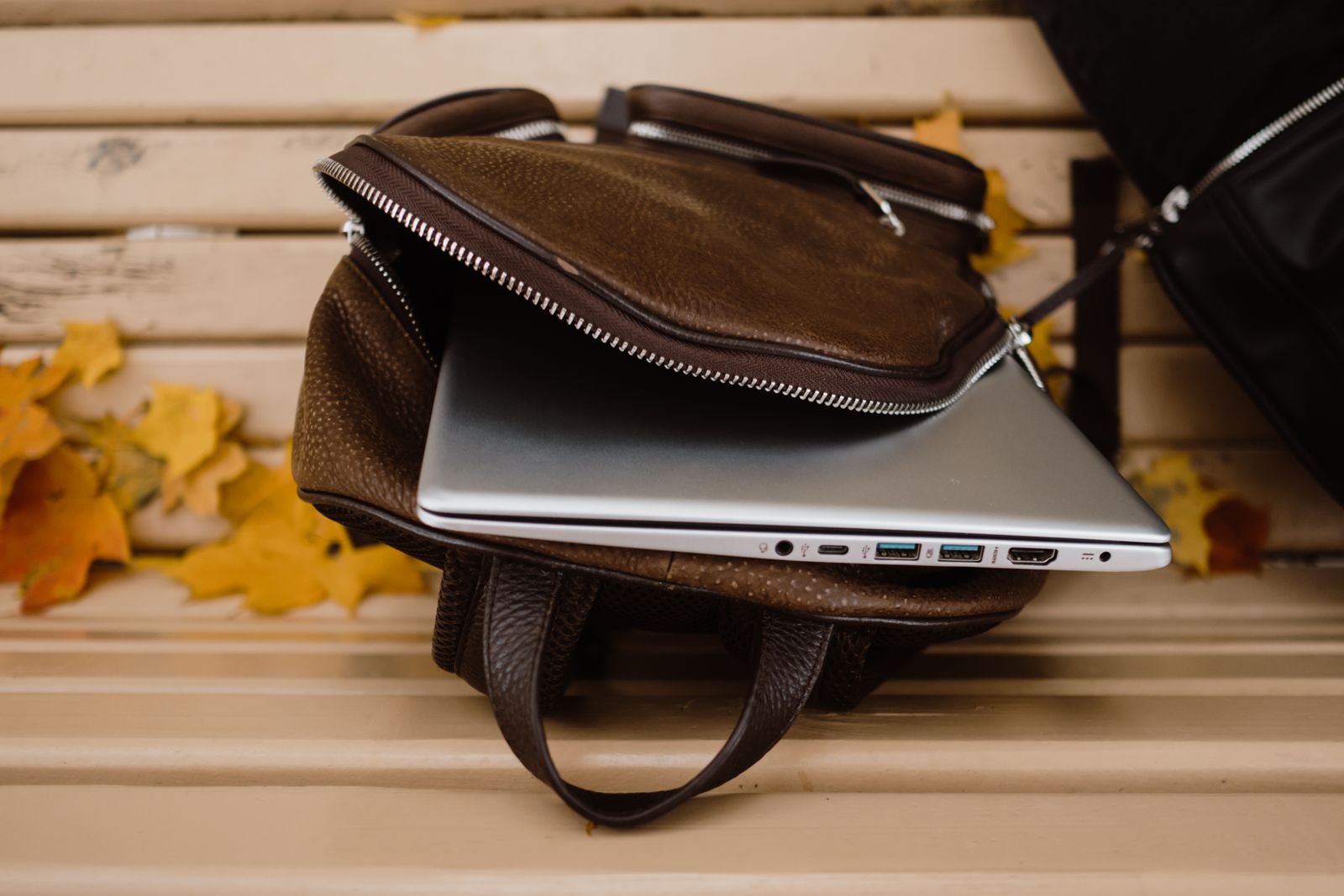
Very few bag makers publish internal laptop-compartment dimensions at all. We found three products that do, across the whole category, and one of them publishes only two of the three axes.
| Bag | Marketed fit | As published | In millimetres |
|---|---|---|---|
| Thule Subterra 2 Backpack 27L | "fits a 16'' PC and 16" MacBook" | 14.0 × 0.7 × 9.8 in (L × W × H) | 355.6 × 248.9 × 17.8 |
| Targus Intellect Essentials 15.6" (TSB966GL) | Product name says 15.6"; the specification on the same page says "16" Laptops and under" | 14.75 × 1.53 in (L × H) — no depth published | 374.7 long × 38.9 thick |
| Targus Corporate Traveler CUCT02B | "up to 16 inches" | 10.20 × 15.10 in (W × H) | 259.1 × 383.5 |
All three product pages read 11 August 2026. Note what the second row does: the same page carries two different fit claims for the same object, one in the product name and one in the specification, and they are half an inch apart. Note what all three rows do: not one of them publishes the three axes a laptop actually has. The Thule row is the only usable one, which is why the chart below tests that bag and not a representative sample — there is no representative sample to test. We also looked at Peak Design and Case Logic and neither publishes internal compartment dimensions at all, only external volume and an inch-fit claim.
So the test below is one bag against four machines. It is not a survey of the market and should not be read as one. It is the only subtraction the published data permits anyone to do.
| Machine | Width vs 355.6 | Depth vs 248.9 | Thickness vs 17.8 | Result |
|---|---|---|---|---|
| Apple MacBook Pro 16 (M5 Pro/Max) | −0.10 | +0.80 | +1.00 | Nominally marginal on width; goes in because fabric gives |
| Lenovo ThinkPad T16 Gen 3 | −4.10 | −1.90 | −1.84 | Over on all three axes |
| Dell Pro 16 Plus PB16250 | −2.40 | −2.50 | −3.55 | Over on all three axes |
| Framework Laptop 16 (graphics module) | −0.98 | −41.30 | −3.15 | Not close |
Every figure in this table is our subtraction of a published machine dimension from a published compartment dimension. Both sides are nominal. A soft compartment stretches, and a published internal dimension is not a tolerance, so a negative number does not prove a machine will not go in — it proves the published numbers leave no clearance and that the inch label carries none of this information. The thickness column uses each maker's published maximum where a taper is published.
Now run the same compartment against the whole fleet in section 1. Of the eighteen configurations in that table, nine clear 355.6 × 248.9 × 17.8 mm on all three axes and nine do not — our arithmetic against the one published compartment we have. Exactly half. Two of the nine failures miss by 0.15 mm on thickness alone: the ThinkPad X1 Carbon Gen 13 with the WUXGA panel, and the ultralight Dell Latitude 7450. Both are 14-inch machines, and both would be waved through by any sleeve-sizing table ever printed, including ours.
The X1 Carbon case is the one to hold on to. With an OLED panel it clears the compartment by 0.85 mm; with the standard panel it is 0.15 mm outside. Neither Lenovo nor Thule publishes a tolerance on the figures either side of that subtraction, so 0.15 mm is a gap between two nominal numbers and not a demonstrated interference. What it does show is that the purchase-order line for the laptop, and not the inch label, is what decides the answer — and the two orders are placed by different departments months apart. No specification written in inches can catch that.
The corollary is the number to put in a tech pack. To clear every configuration in section 1 up to and including the 16-inch class, a laptop compartment needs an internal 365 × 258 × 24 mm — the widest machine plus roughly 5 mm, the deepest plus roughly 7 mm, the thickest plus roughly 3 mm. The headroom figures are ours and are an assumption, not a sourced tolerance; the machine maxima underneath them are published. If the fleet includes a Framework Laptop 16 with a graphics module, depth has to go to 297 mm, which is 48.1 mm more than the only published compartment in the category.
What this means for you: put internal compartment dimensions on the tech pack as three numbers in millimetres, and make them a measured acceptance criterion on the pre-production sample. A supplier who agrees to "fits 16 inch" has agreed to nothing testable. A supplier who agrees to 365 × 258 × 24 mm internal has agreed to something you can hold a ruler against when the sample lands, and something with a right answer when a disagreement about a bulk shipment gets settled. If you take one line from this page into a document, take that one.
3. There is no standard for protecting what is inside the bag
The previous version of this page specified "EVA foam padding, 8 to 12mm thick on the device-facing side". We went looking for the standard that number is measured against, on the assumption that a figure that specific must be quoting something. It is not quoting anything: nothing in the world's standards catalogues specifies a test method or a performance level for laptop-compartment impact protection.
A null result stated vaguely is worthless, so here is exactly how hard it was looked for. The ANSI Webstore search for laptop bag returns, verbatim, "Sorry, your search returned no results." Zero standards. The search for backpack returns ten, and here is what they are about.
| Subject | Standards returned | Designations |
|---|---|---|
| Backpacking tents | 3 | ASTM F1933, F1934, F1935 |
| Backpack radiation detectors | 2 | BS EN IEC 62694:2024, GB/T 41646-2022 |
| Backpack capacity, in litres | 1 | ASTM F2153-07(2018) |
| Backpack-mounted brush-cutters | 1 | BS EN ISO 11806-2:2022 |
| Child harnesses with backpacks | 1 | DS/EN 13210-2:2020 |
| Not identified on the results page | 2 | Titles not captured — shown as unidentified rather than assumed |
| Protecting what is inside the bag | 0 | Nothing |
Eight of the ten results were identified by title on the results page and are grouped above; two were not captured, and are counted as unidentified rather than folded into a category to make the point cleaner. A parallel search of the ISO catalogue for laptop bag returned no ISO standard for laptop bags, backpacks or luggage protection.
The one backpack standard that exists is worth reading precisely, because its name gets borrowed. ASTM F2153-07(2018), "Standard Test Method for Measurement of Backpack Capacity", from committee F08.22, measures unextended and extended volume. It cannot reliably measure below 4 litres and states that it does not address safety concerns. It establishes that a bag sold as 27 L is 27 L, and says nothing about what happens to a laptop inside one.
Two other standards get produced in this conversation and neither is about a bag. ASTM D5276, the free-fall drop test of loaded containers, covers packaging and shipping containers. IEC 62133-2:2017, amended 2021, covers portable sealed secondary lithium cells, with "power bank" among its own keywords — a battery you might carry in a bag, not the bag. Both are real. Neither can be cited for compartment protection.
What this leaves in the specification, and it is not nothing. Testing houses such as Bureau Veritas and Intertek will run drop, abrasion, seam-strength and zip-cycle protocols on a bag. Those are real tests with real results. But they are retailer-specified protocols — the buyer writes the parameters — not published standards, so two suppliers' "passed drop testing" claims are not comparable to each other and neither is comparable to yours. If protection matters to your programme, the honest route is to write the protocol yourself, name the laboratory, and hold the report. The dishonest route is to specify a foam thickness and imply it means something.
The absence of a standard leaves the load undefined too. The machines in section 1 run from 0.986 kg for a ThinkPad X1 Carbon Gen 13 in the V-series configuration to 2.40 kg for a Framework Laptop 16 with a graphics module — a spread of 2.4 times, our division of the two published figures. A harness adequate for the first is carrying nearly two and a half times as much for the second, and nothing anywhere defines "adequate" for either.
What this means for you: delete every padding thickness and protection rating from your specification unless you commissioned the test yourself, and replace them with a named protocol, a named laboratory and a report you hold. Ours are deleted. If a supplier offers a "drop-tested" compartment, the only useful follow-up is which document specifies the test — and unless they commissioned it, the answer cannot be a published standard, because there is not one.
4. MIL-STD-810 is not a thing a backpack can pass
The related claim is more specific and easier to check. MIL-STD-810 is a real document — "Department of Defense Test Method Standard: Environmental Engineering Considerations and Laboratory Tests", Revision H, dated 31 January 2019 — and the drop test everybody means is Method 516.8 Procedure IV, Transit Drop. What the standard says about itself disposes of the marketing claim.
| Point | The standard's own words |
|---|---|
| It is not a specification | "this document does not impose design or test specifications. Rather, it describes the environmental tailoring process that results in realistic materiel designs and test methods based on materiel system performance requirements." |
| Tailoring is compulsory | "Tailoring is essential. Select methods, procedures, and parameter levels based on the tailoring process." (Method 516.8) |
| What Procedure IV is | "a physical drop test, and is intended for materiel either outside of, or within its transit or combination case, or as prepared for field use (carried to a combat situation by man, truck, rail, etc.)" |
| What Procedure IV is not for | "This procedure is not intended for shocks encountered in a normal logistic environment as experienced by materiel inside bulk cargo shipping containers (ISO, CONEX, etc.)." |
| Test axes | "subject the test item to a sufficient number of suitable shocks to meet the specified test conditions in both directions along each of three orthogonal axes" |
Quotations are US Department of Defense text and retain US spelling. Method 516.8 was read from two verbatim third-party reproductions of the DoD text (cvgstrategy.com and trentonsystems.com) because the full 810H document exceeded the fetch size limit; the document metadata is from EverySpec. This is flagged rather than hidden: the wording above is DoD wording, obtained from mirrors.
Three consequences follow, and all three are the standard's, not ours. First, MIL-STD-810 sets no pass or fail threshold. The drop height, number of drops, orientations and the definition of "survived" are chosen by whoever commissions the test, under a tailoring process the standard makes mandatory. There is no level to reach. Second, there is no certifying body. The Department of Defense issues no MIL-STD-810 certificates or marks, so every "MIL-STD-810 certified" claim in consumer goods is a self-declaration against a self-selected tailoring. Third, Procedure IV tests materiel — the equipment — optionally inside its transit case. A backpack dropped empty demonstrates nothing about a laptop.
This is not an accusation that suppliers making the claim are lying; a factory that paid for a genuine 810H tailoring did have a real test run. The claim is simply not comparable between two suppliers, and it is not a level anyone can be held to, which is what a buyer thinks they are getting.
What this means for you: if a quotation says MIL-STD-810, ask for the tailoring — the method, the procedure, the drop height, the number of drops, the orientations, the test item, and the pass criterion. A supplier with a real report can produce all seven in an afternoon. A supplier repeating a phrase will produce a certificate, and there is no such thing as a MIL-STD-810 certificate. That question costs nothing to ask and it is the fastest supplier diagnostic on this page.
5. The power-bank rules changed on 27 March 2026, and most product copy has not caught up
Everything so far has been the absence of rules. This is the opposite: a hard, dated change that reaches straight into what a corporate laptop backpack is allowed to do, and which a good deal of "charging backpack" marketing now describes as a feature.
On 27 March 2026, ICAO amended the Technical Instructions for the Safe Transport of Dangerous Goods by Air (Doc 9284). In ICAO's own words, "these devices will now be limited to two per passenger, and passengers will be prohibited from recharging them during flights." IATA issued guidance to operators dated 31 March 2026, which separates power banks from spare batteries as a distinct regulatory category for the first time and removes the 100–160 Wh band for power banks entirely.
| Category | Up to 100 Wh | 100–160 Wh | Above 160 Wh |
|---|---|---|---|
| Battery installed in a device | Carry-on or checked. Checked only if the device is "completely switched off (not in sleep or hibernation mode)" | Operator approval required | Not permitted |
| Spare battery, loose | Carry-on only, no approval needed | Operator approval required, carry-on only | Not permitted |
| Power bank, from 27 March 2026 | Carry-on only. Maximum two per passenger. Must not be recharged on board. Must be individually protected against short circuit | Band removed | Not permitted |
IATA, "Changes Regarding Power Banks", guidance to operators, 31 March 2026, and "Passengers Travelling with Lithium Batteries", 31 March 2026, which also caps a passenger at 20 spare batteries and 15 portable electronic devices. The IATA guidance runs until 31 December 2026, when the 68th edition of the Dangerous Goods Regulations takes effect. The FAA's PackSafe page, last updated 16 April 2026, states that "Spare lithium batteries (including power banks and portable chargers) must be carried on and cannot be checked", allows 101–160 Wh with airline approval to a maximum of two spares, and gives the conversion as Wh = V × Ah. Individual airlines may be stricter than any of this; nothing here substitutes for the operating carrier's conditions of carriage.
Read the middle row of that table against the way integrated-battery backpacks are sold. "Charge your laptop in the air" is now a description of behaviour that IATA's guidance says must not happen: power banks "must not be recharged while onboard the aircraft", and operators recommend that they "should not be used to recharge a portable electronic device while onboard". A bag whose selling proposition is in-flight charging is marketing something the rules changed four months before this page was written.
There is a quieter trap too. A power bank supplied loose inside a welcome kit counts against the passenger's limit of two, so an employee carrying the company unit plus their own is already at a ceiling that did not exist in 2025. Not a product defect, but worth knowing before an onboarding kit ships several thousand of them.
What this means for you: if the bag or the kit contains a power bank, cap it at 100 Wh, print the watt-hour rating on the product and the packaging, and delete any in-flight charging claim from the copy. The 100–160 Wh band no longer exists for this category. Ask the supplier for rated watt-hours, not milliamp-hours — the FAA formula is Wh = V × Ah, and a milliamp-hour figure without the rated voltage cannot be converted, which is why we have not converted one here.
6. Whether the battery is in the bag or beside it decides your freight terms
The same cell, in two different places in the carton, ships under two different UN numbers with two different rule sets. It is a logistics decision that looks like a product decision, and it is usually taken by whoever draws the bag.
| Configuration | UN number | State-of-charge ceiling | What it means in practice |
|---|---|---|---|
| A pallet of loose power banks, shipped alone | UN 3480 — lithium ion batteries shipped not in or with equipment | 30% of rated capacity, mandatory | The factory cannot despatch charged units. Charge-testing before packing has to be followed by discharging |
| A backpack with a built-in, non-removable cell | UN 3481 — contained in equipment | 30%, or 25% indicated capacity, recommended only | No mandatory ceiling. Different documentation and packaging |
| A backpack and a loose power bank in the same carton | UN 3481 — packed with equipment | Recommended only | The bundling decision, not the cell, is what moves it out of UN 3480 |
IATA Lithium Battery Guidance Document, 67th edition of the Dangerous Goods Regulations, effective 1 January 2026. Section II applies to cells of 20 Wh or less and batteries of 100 Wh or less. Cells and batteries must be tested to sub-section 38.3 of the UN Manual of Tests and Criteria before transport — Revision 8 (2023) with Amendment 1 (2025). The reading of these three configurations against your carton plan is ours, applying the published definitions; it is an inference from the rule text, not a quoted ruling, and your freight forwarder's dangerous-goods desk is the party who should confirm it against the actual packing list.
The asymmetry runs against intuition. The more integrated design — a cell sealed into the bag — carries the lighter transport obligation on state of charge, because it is equipment rather than cargo of batteries. Power banks on a pallet carry the hard 30% cap. A buyer who separates the power bank from the bag to keep the bag a textile SKU has just moved the battery into the stricter transport category.
That is not abstract. A 30% ceiling means the factory's quality process cannot end with a full-charge functional test unless it also ends with a controlled discharge, and it means units arrive near-flat — which is the state the recipient opens the welcome kit in. Neither is a problem; both are things to agree before the first purchase order rather than discover on the first shipment.
What this means for you: decide the packing configuration before the tooling, and put the UN number on the purchase order. If the programme ships power banks as a separate line item, plan for 30% state of charge, plan for the arrival condition that produces, and confirm the classification with the forwarder rather than the factory. If it ships them inside the bag, the transport question gets easier and the next one gets much harder.
7. A battery turns a textile SKU into an electrical SKU, and the design has an expiry date
This is the finding with the largest commercial consequence on the page, and the old version of this article did not mention any part of it. Adding a cell or charging electronics does not add a feature to a bag. It changes what the product legally is.
| Instrument | The test it applies | What it obliges |
|---|---|---|
| WEEE — Waste Electrical and Electronic Equipment Regulations 2013 (SI 2013/3113), reg. 2 | "EEE" means "equipment which is dependent on electric currents or electromagnetic fields in order to work properly… designed for use with a voltage rating not exceeding 1,000 volts for alternating current and 1,500 volts for direct current" | Producer registration and financing of collection and treatment. "Producer" catches anyone who places EEE on the market professionally from a third country, and anyone reselling another supplier's equipment under their own name |
| EMC — Electromagnetic Compatibility Regulations 2016 (SI 2016/1091), reg. 2 | "apparatus" means "any finished appliance or combination thereof made available on the market as a single functional unit, intended for the end-user and liable to generate electromagnetic disturbance, or the performance of which is liable to be affected by such disturbance" | Conformity assessment and a declaration of conformity under reg. 10(1)(a) |
| Battery safety — IEC 62133-2:2017 (Ed. 1.1 with AMD1, 2021) | "specifies requirements and tests for the safe operation of portable sealed secondary lithium cells and batteries containing non-acid electrolyte, under intended use and reasonably foreseeable misuse" — keywords include "power bank" | Cell and battery safety testing |
| Transport — UN Manual of Tests and Criteria, sub-section 38.3 | Applies to cells and batteries before transport | UN 38.3 test report |
| EU batteries — Regulation (EU) 2023/1542 | Portable batteries in appliances | Article 11 removability and replaceability — see below |
The UK has not adopted Regulation (EU) 2023/1542; UK obligations sit under the placing-on-market regime and the Waste Batteries and Accumulators Regulations 2009 (SI 2009/890), which require delivery of waste portable batteries to an approved treatment operator or exporter, four years of written records of tonnage collected and delivered by chemistry, and quarterly reporting of tonnage first placed on the UK market. RoHS also attaches, and is named here without a clause reference because we did not read the instrument for this article.
The boundary case needs care, and we are marking our reading as a reading. [Inference, legal analysis and not legal advice.] A backpack with nothing but passive routed cabling and a pass-through USB connector is arguably not "dependent on electric currents in order to work properly" as a bag — but the connector itself is arguably EEE, and most compliance practice treats it as such. A backpack with an integrated cell or charging electronics plainly satisfies both the WEEE "EEE" test and the EMC "apparatus" test. And a backpack bundled with a separately manufactured power bank puts that power bank's obligations on whoever placed it on the market — which is you, if it carries your name or you imported it, because WEEE reg. 2 catches rebranding in terms.
The dated part, and the reason a 2026 tooling decision matters. Article 11 of Regulation (EU) 2023/1542 applies from 18 February 2027 — that date is the European Commission's, in Commission Notice C/2025/214 of 10 January 2025, which states that "Article 11 of Regulation (EU) 2023/1542 is applicable from 18 February 2027". From that date, a portable battery in an appliance placed on the EU market must be removable and replaceable by the end user. Recital 38 of the Regulation frames removability as removal "with the use of commercially available tools". The Commission's guidelines confirm that portable batteries "can be present in a wide range of products" and list derogations for medical devices, wet-environment appliances and safety-critical equipment — a backpack is none of those three.
So a sealed, glued-in USB power cell in a backpack is a design with a known end date in the EU market. Tooling laid down in 2026 for 2027 delivery needs either a user-swappable cell or a detachable power bank. Counting from the date of this page, that is a little over six months of runway, not five years of amortisation.
The commercial summary is one sentence. A textile SKU carries a fabric specification and a duty line; an electrical SKU carries UN 38.3, IEC 62133-2, RoHS, EMC conformity assessment and declaration, WEEE producer registration and financing, battery producer registration, and — for the EU from February 2027 — a removability requirement that constrains the mechanical design. Different product, different cost base, different compliance owner, and the decision to become it is usually taken in a sentence of a creative brief.
What this means for you: treat "add a power bank" as a change of product category and price it as one, or keep the battery out of the bag entirely. For a welcome-kit programme the second option is frequently right and almost never considered, because the integrated version demonstrates better. If you do integrate, specify user-removability now rather than in 2027, and make sure whoever will be the WEEE and battery producer knows they are it — very often the buyer, not the supplier.
8. The hidden security pocket defends against something with no confirmed case
The old version of this page listed a "hidden security pocket: back panel pocket for wallet, passport, or building access card" among the features knowledge workers use. That is a fair description of a pocket. What gets sold alongside it in this category — RFID-blocking — does not survive its own numbers, and those numbers are published by the banking industry and the police.
Start with the technology. The relevant standard is ISO/IEC 14443, and the word in its own title is proximity: "Cards and security devices for personal identification — Contactless proximity objects". The Smart Card Alliance's Contactless Payments Security Q&A of December 2016 puts the operating range at "less than 1-2 in. away" from the terminal, states that "Every contactless payment transaction includes dynamic data that is unique for that transaction. Stolen or intercepted transaction data can't be used for other transactions", and that "personal information such as the cardholder name cannot be read" over the contactless interface. It records that the industry has "only seen incomplete demonstrative attempts to read information from contactless-enabled cards, not used to conduct actual fraud". The document nowhere recommends RFID-blocking sleeves or wallets. Its only consumer advice is "not leaving their card or device unattended."
| Figure | Amount | Does a shielded pocket in a bag address it? |
|---|---|---|
| Contactless fraud, 2025 | £46.8m, up 8% on 2024 | Not on the published mechanism — see the quotation below |
| Lost and stolen card fraud, 2025 | £109.8m across 449,189 cases | No — the card has left the bag |
| Remote purchase card fraud, 2025 | £423.5m, up 3% | No |
| Total card fraud losses, 2025 | £594.9m | — |
| Authorised push payment fraud, 2025 | £576.4m, up 19% — the fastest-growing category | No |
| Total fraud losses, 2025 | £1.28bn, up 4% | — |
| Contactless fraud rate, data year 2023 | 1p per £100 spent, against 5.8p for unauthorised card fraud overall | The whole contactless category is already the low-rate one |
| Contactless share, data year 2023 | 8% of card fraud losses, while 73% of card transactions were contactless | — |
UK Finance, Annual Fraud Report 2026, published 15 June 2026 for data year 2025, and the accompanying press release, for every 2025 figure. The 1p and 5.8p ratio and the 8%/73% pair are from UK Finance's Annual Fraud Report 2024, published May 2024, and are therefore for data year 2023 — the 2025 edition is disallowed by robots.txt and was not obtained, so we cannot give the current ratio. All figures are in pounds sterling and no conversion to any other currency is applied or implied anywhere on this page.
Now the mechanism, in UK Finance's own words rather than ours: "UK retail face-to-face card fraud covers all transactions that occur in person in a UK shop, including contactless. Much of this fraud is undertaken using low-tech techniques, with fraudsters finding ways of stealing the card, and often the PIN, to carry out fraudulent transactions in shops. This includes criminals using methods such as ATM card entrapment and distraction thefts, combined with shoulder surfing and PIN pad cameras." Every mechanism named there happens after the card has left the bag.
And the flattest statement we found, from West Yorkshire Police: "There have never been any confirmed reports of money being 'stolen' from a contactless card still in a cardholder's possession in the UK." The same page adds that "waving a card reader about in the street or on a train couldn't take a payment from passers-by", that "You have to be extremely close to someone for their gadget to be able to read your card", and that anything read "would only get the card number and expiry date which is the same information you see by simply looking at the front of any card". The page carries no publication date, which we note rather than hide.
For scale, one piece of our own arithmetic. In January 2026 there were 1.437 billion UK contactless transactions worth £23.5bn. [Derived] Annualised by multiplying by twelve, that is roughly £282bn a year, so £46.8m of contactless fraud is 0.0166% of spend, or about 1.7p per £100. The annualisation assumes January is a typical month, and we could not test that assumption: only monthly card spending updates were found and no annual total, so this is one month multiplied by twelve and should be read as an order of magnitude rather than a measurement. It lands in the same place as UK Finance's published 1p for 2023.
The honest version of the claim exists and nobody makes it. Legacy 125 kHz office access-control fobs are a different technology from ISO/IEC 14443 payment cards, and they are genuinely cloneable — which is exactly what a tech-office or coworking staff kit contains, and exactly what the old version of this page proposed putting in the hidden pocket alongside the wallet. [Inference: this is our reading of the threat model, and we did not obtain a published cloning study or a shielding-effectiveness test to cite for it, so we are not presenting it as a sourced finding.] A bag brand could make a defensible security claim about door credentials. The shorthand "RFID equals credit cards" sells better, so nobody does.
What this means for you: if your security team is in the approval chain, do not put RFID-blocking in the specification, because there is no answer to the question of what threat it mitigates. It is a costless line to add and it is not a control. The pocket itself is fine — a back-panel pocket against the wearer's spine is a sensible place for a wallet on a commuter train, and that is a physical-security argument that does not need a shielded lining to be true.
9. The two numbers your programme is sized against are not measured
Every laptop backpack programme is budgeted off two assumptions: a laptop refresh cycle, and a growth story about flexible workspace. We tried to source both. One has no official statistic behind it at all; the other is almost entirely published by firms with a commercial position in it.

On refresh cycles: no national statistical office, government department or official statistical release publishes how often companies replace laptops. Searches of gov.uk, ONS-adjacent releases, EU Joint Research Centre ecodesign material and US federal sources returned nothing usable. The "three-year refresh cycle" is folklore. What exists is tax law and vendor research, and they are different kinds of object.
| Anchor | Figure | What kind of source this is |
|---|---|---|
| MACRS class life for computers and peripheral equipment | 5-year property, 26 U.S.C. §168(e)(3)(B) via "qualified technological equipment" at §168(i)(2) | Statute. A depreciation life, not a behavioural fact |
| Windows 10 end of support | 14 October 2025. Retirement timestamp 15 October 2025, 06:59:59 PT; 22H2 the final version | Manufacturer primary source (Microsoft Lifecycle). The actual forcing function |
| Q3 2025 global PC shipments | 75.8m units, +9.4% year on year | Vendor. IDC market research press release, 8 October 2025 |
| Q4 2025 and full-year 2025 shipments | 71.5m units (+9.3%); full year above 270m units (+9.1%) | Vendor. Gartner market research press release, 20 January 2026 |
| Companies getting over four years out of laptops | 26%; capitalisation periods "generally 3–5 years" | Vendor. Forrester analyst blog, no publication date shown on the page |
| UK government policy direction | "Instead of replacing devices on a fixed schedule, we will monitor device performance." Around 90% of Defra laptops, phones and tablets to be refurbished or remanufactured over a five-year contract | Government source, 18 February 2026 — but a policy statement, not a statistic |
Gartner attributes the 2025 surge to "Tariff volatility, anticipated memory price hikes in 2026, and rising costs associated with Windows 10 Extended Security Updates"; IDC to "the Windows 11 transition and the need to replace an ageing installed base". Both are quotations from vendor press releases and both are marked. Forrester's page also reports laptop price increases of "10–15% or more" and that "just under 40% of companies were planning to implement or had already implemented BYOD in 2025"; neither figure carries a date on the page and neither should be planned against.
The reading we would defend: the 2025–26 shipment surge is explained better by a dated end-of-support event and a five-year statutory class life than by any survey of intent. The only hardware refresh anyone can put a date on is the one that has already happened.
On coworking, there is exactly one audited number in the whole category. IWG plc, the largest operator and a listed company, ended 2025 with 4,609 open centres in over 120 countries at 76% occupancy, on system-wide revenue of $4.453bn, up 4% on $4.297bn in 2024 — 782 centres opened and 1,132 signed during the year, with over a million rooms open and over 230,000 in the pipeline. Those figures are from the FY2025 results presentation of 3 March 2026 and they are audited listed-company disclosure. Everything else we found about coworking growth is published by someone selling into it: CoworkingCafe is a Yardi Systems company and Yardi sells software to the sector; CBRE brokers flexible office deals; Deskmag is industry media running an operator survey whose sample size and methodology are not published.
The instructive part is what happened to the forecast. CBRE's 2019 flexible office report put US flexible space at 71m sq ft, 1.8% of office stock, and projected roughly 13% — up to 600m sq ft — by 2030. CBRE's own 2023 brief put it at "only 1.7% of total U.S. office inventory". CoworkingCafe's April 2026 figure is 165.6m sq ft across 9,254 locations, 2.3% of total leasable US office inventory. Whatever definitional drift sits between those three publishers, and there is some, the category is not on a path to 13%. No national statistical office — not ONS, Eurostat, Census or BLS — publishes a coworking series at all.
What this means for you: size the programme against your own headcount plan and your own member roster, and treat every market-growth figure in a supplier's deck as a sales document until it names an audited source. For a multi-site operator, IWG's 76% occupancy is a more useful planning input than any growth percentage, because it is a measured utilisation figure and utilisation is what turns into bags.
A worked example, with the arithmetic shown
Take a company or a coworking operator specifying one bag for a mixed fleet. Every input below is a published figure with its source named, our own arithmetic on published figures, or an assumption — and each row says which. There are no prices in this example, for the reason set out below: we could not source a single one.
| Step | Figure | Source, or assumption |
|---|---|---|
| Fleet, as assumed for this example | MacBook Air 13 and Pro 14, ThinkPad X1 Carbon Gen 13, Dell Latitude 7450, HP EliteBook 840 G11, plus a handful of 16-inch machines: MacBook Pro 16, ThinkPad T16 Gen 3, Dell Pro 16 Plus | Assumption. A plausible corporate mix, not a surveyed one. No published fleet-composition data was found and none is claimed |
| Widest machine in that fleet | 359.70 mm | ThinkPad T16 Gen 3, Lenovo PSREF specification PDF |
| Deepest machine in that fleet | 251.40 mm | Dell Pro 16 Plus PB16250, Dell owner's manual |
| Thickest machine in that fleet | 21.35 mm | Dell Pro 16 Plus PB16250, published maximum, Dell owner's manual |
| Compartment specification, with headroom | 365 × 258 × 24 mm internal | Our arithmetic on the three rows above. The headroom — 5.3, 6.6 and 2.65 mm respectively — is our assumption. No published tolerance convention exists to appeal to |
| Shortfall of the only published compartment in the category against that specification | 9.4 mm short on length, 9.1 mm short on depth, 6.2 mm short on thickness | Our subtraction of Thule's published 355.6 × 248.9 × 17.8 mm from the row above |
| Configurations from section 1 that clear the Thule compartment on all three axes | 9 of 18 — exactly half | Our arithmetic, comparing every published configuration in section 1 against 355.6 × 248.9 × 17.8 mm |
| Of the nine that fail, how many fail by under 0.5 mm on their worst axis | Five. MacBook Pro 16 by 0.10 mm on width; ThinkPad X1 Carbon Gen 13 with the WUXGA panel and the ultralight Dell Latitude 7450 by 0.15 mm on thickness; the mainstream Dell Latitude 7450 and the 7450 2-in-1 by 0.41 mm on thickness | Our arithmetic on the same published figures |
| Thickness variation within the nominally identical 14-inch class | 5.81 mm, from 12.40 mm (HP EliteBook 8 G1i) to 18.21 mm (Dell Latitude 7450 mainstream) | Our subtraction across the 14-inch rows in section 1. For scale, that is roughly a third of the entire 17.8 mm thickness of the published Thule compartment |
| If the fleet includes a Framework Laptop 16 with a graphics module | Depth requirement rises to 297 mm — 48.1 mm more than the published Thule compartment | Framework specification tab (290.2 mm) plus our headroom assumption; the 48.1 mm is our subtraction |
| Load the harness has to carry, across the same fleet | 0.986 kg to 2.40 kg — a spread of 2.4 times, or 1.414 kg | Lenovo PSREF (X1 Carbon Gen 13, V-series) and Framework (Laptop 16 with graphics module). The ratio and the difference are ours |
| Protection specification to write against those loads | None available | No published ASTM, ISO, IEC, EN or BS standard specifies compartment protection. See section 3. A named private protocol is the only option |
| If a power bank is included | Cap at 100 Wh; maximum two per passenger; carry-on only; no in-flight recharging | IATA guidance to operators, 31 March 2026, following the ICAO amendment effective 27 March 2026 |
| Converting a milliamp-hour rating to watt-hours | Not done here | The FAA gives Wh = V × Ah. Without the manufacturer's rated voltage the conversion is not possible, and we will not assume a nominal cell voltage in order to print a number |
| Unit cost, kit cost, minimum order quantity | No figure | Withdrawn. Nothing published was found to check any of them against. See "What we could not verify" |
Three things fall out of this table. The compartment specification a mixed corporate fleet actually needs is larger on every axis than the only compartment anyone in the category publishes. Half of a plausible fleet does not clear that compartment on the published numbers, and two of the failures are 14-inch machines missing by 0.15 mm — which no inch-based sizing table can see. And the harness is being asked to carry a load that varies by a factor of 2.4 with no standard defining adequacy at either end. None of that is visible in a specification written in inches, which is how essentially all of them are written, including the one this page used to publish.
What to put in the specification, and what to ask the supplier
This is the part to screenshot. Each row is either a line for the tech pack or a question for the quotation, and each one exists because of a finding above. Four of the rows exist because no published convention exists to inherit, which is exactly why they have to be written down by you.
| Specify or ask | Why | A non-answer sounds like |
|---|---|---|
| 1. Internal compartment dimensions in millimetres, on all three axes | The inch label does not sort the machines. A 14-inch ThinkPad is shallower than a 13-inch MacBook Air | "Fits up to 16 inch" |
| 2. The largest published maximum thickness in your fleet, not the average | Makers publish a front and rear taper; the maximum is what the sleeve clears. Two machines in our example miss by 0.15 mm | A single thickness with no taper stated |
| 3. The fleet listed by model and configuration, not by screen size | The display option moves thickness by up to 1.0 mm on the same model number | "Mostly 14-inch machines" |
| 4. Depth stated explicitly and separately | Within the 16-inch class, depth varies by 42.1 mm against 4.0 mm of width. It is the axis that fails and the axis nobody prints | Two dimensions where there should be three |
| 5. The compartment measured on the pre-production sample, with the tolerance stated | No published tolerance convention exists. If you do not state one, there is not one | A drawing with no tolerances on it |
| 6. Any protection claim traced to a named protocol, a named laboratory and a report you hold | There is no published standard for compartment protection in any catalogue | "Drop-tested" with nothing behind it |
| 7. For MIL-STD-810: the method, procedure, drop height, number of drops, orientations, test item and pass criterion | The standard mandates tailoring and sets no threshold. There is no certifying body | A "MIL-STD-810 certificate", which does not exist |
| 8. Padding specified by function and verified by your own test, not by a foam thickness | No standard defines adequacy. Our own 8–12 mm figure is withdrawn for exactly this reason | A millimetre figure presented as though it were a rating |
| 9. Whether the product contains a cell, charging electronics, or only passive cabling | The first two make it EEE under WEEE reg. 2 and apparatus under EMC reg. 2. The third is arguable | "It has a USB port" with no further detail |
| 10. Named in writing: who is the WEEE producer and who is the battery producer | WEEE reg. 2 catches rebranders and third-country importers. That is frequently the buyer | "The factory handles compliance" |
| 11. For EU delivery from 18 February 2027: the battery user-removable with commercially available tools | Article 11 of Regulation (EU) 2023/1542, per Commission Notice C/2025/214 | A glued-in cell quoted for 2027 production |
| 12. The UN number the shipment will move under, and the state of charge on arrival | UN 3480 is capped at 30% state of charge; UN 3481 is not. Bundling decides which | A packing list with no dangerous-goods line |
| 13. Watt-hours printed on the power bank and its packaging, at 100 Wh or below | The 100–160 Wh band was removed for power banks on 27 March 2026 | A milliamp-hour figure with no rated voltage |
| 14. RFID-blocking: which threat, with a citation | UK Finance attributes contactless fraud to card theft. No UK police force records a confirmed proximity-read case | "For security" — the whole answer |
Rows 5, 6, 7 and 8 are the four with no published practice behind them anywhere we could look. That is not a reason to skip them; it is the reason they are the four most valuable rows on the list, because a term with no custom behind it is settled entirely by whoever writes it down first. Row 1 is the one that pays for the exercise.
Sourcing a laptop backpack programme with Backper, on this page's own terms
Applying the tests above to our own previously published page produces a list we would rather not print.

| Test | Where we stand |
|---|---|
| "A 14-inch sleeve fits 13- and 14-inch laptops; a 16-inch sleeve fits 15- and 16-inch laptops" | Withdrawn. False in both directions on the makers' published dimensions. A 14-inch X1 Carbon is shallower than a 13-inch MacBook Air, and the only published 16-inch compartment we could find is over-run by two mainstream corporate 16-inch machines on all three axes |
| "17-inch sleeve for workstation-class machines" | Withdrawn. We hold no published dimensions for any 17-inch machine and will not specify a compartment for a class we did not source |
| "EVA foam padding, 8 to 12mm thick" | Withdrawn. There is no standard against which any thickness could be shown to be adequate, so the figure was decoration. We will specify padding to your written protocol and hold the report |
| "A bag that does not protect a modern MacBook Pro or Dell XPS will be replaced within a year" | Withdrawn. We have no product-life data and found none published. It was an assertion dressed as a finding |
| Landed cost of $32–$52 at 500 units and $48–$85 at 1,000; kit cost "$100 to $200 all-in"; MOQ 300–500 with 100–200 reorders | All withdrawn. No published price benchmark for this category was found from any source. We will quote your specification; we will not restate a range as though it were a market |
| "A premium laptop backpack outperforms a t-shirt by a wide margin in terms of post-event use" | Withdrawn. No study, no measurement, no source |
| The sustainability specification: GRS-certified rPET, PFAS-free DWR, recycled-content zippers, FSC hangtag | Not withdrawn, but not evidenced on this page either. We did not research the certification schemes for this rewrite and will not carry claims through unexamined. Ask us for the scheme certificates by number and we will send them or tell you we do not hold them |
| Compartment dimensions in millimetres | We did not publish them and almost nobody does. We will put them on the tech pack and make them a measured acceptance criterion on the sample. This is the one thing on this page we would change first |
| MIL-STD-810 or "drop-tested" | We do not claim either and will not. We will run a protocol you specify at a laboratory you name |
| RFID-blocking | We will build it if you specify it and we will not sell it as a security control, because on the published fraud data there is no threat to attach it to |
| Integrated batteries and power banks | We are not your WEEE producer, your battery producer or your EMC declarant if you are the importer or the brand — those obligations follow the name on the product. From 18 February 2027 an EU-bound integrated cell must be user-removable, and we will not tool a glued-in cell for 2027 delivery |
| Everything in this column | Self-reported and unaudited, and evidenced on request |
Six of these twelve rows record something withdrawn. The seventh records something we have decided not to defend without checking.
The specification, not the quotation, is where this programme is won. If you are scoping bags for a tech company, an IT department or a coworking operator, send us the fleet by model and configuration code rather than by screen size, the destination markets, and whether a battery is going anywhere near the product. Those three answers change the specification more than any feature list — and the first one is the only way to get the compartment right.
You can see current silhouettes in the business collection and the custom and branded collection, and ask our team for a quote. We will put the internal compartment dimensions in millimetres on the quotation, and we will tell you which of your machines they clear.
Related reading. For what a sample can and cannot settle, see the sampling guide. For the schedule this sits inside, lead times for wholesale custom backpacks, and for the freight and customs legs, shipping, freight and customs.
What we could not verify
- Any published price for a wholesale laptop backpack, at any quantity, from any source. Our deleted ladder — $32–$52 at 500 units, $48–$85 at 1,000, kits at $100–$200 — cannot be checked, and neither can anyone else's. This page prints no price, no minimum order quantity and no kit cost as a result.
- Published laptop-compartment internal dimensions from Peak Design and Case Logic. Both product pages omit them, giving only external volume and a marketed inch fit. That absence is itself evidence for the argument in section 2, but it could not be turned into table rows, which is why the clearance test runs against one bag rather than a sample.
- Table 516.8-IX of MIL-STD-810H — the actual transit-drop heights by test-item weight. The full 810H document exceeded the fetch size limit and the Method 516.8 extract stopped before the table. Procedure IV's scope and purpose text was obtained; the numeric drop heights were not, so this page states that the heights are chosen by the commissioner without printing what the standard's own table suggests.
- The verbatim text of Regulation (EU) 2023/1542 Articles 3, 11, 13, 55 and 56. EUR-Lex truncated at around recital 100 across four separate fetch attempts. Confirmed only: entry into force 17 August 2023, from the ELI metadata, and the 18 February 2027 application date for Article 11, from Commission Notice C/2025/214. The Regulation's general date of application, widely stated elsewhere as 18 February 2024, could not be confirmed from a primary source and is therefore not stated on this page.
- The exact text of ICAO Addendum No. 1 to the 2025–2026 Technical Instructions on power banks. The ICAO news release and the IATA operator guidance were obtained and are quoted; the addendum itself was not fetched.
- The current amendment status of IEC 62133-2 beyond AMD1:2021. The IEC page lists a stability date of 2026, which implies a revision may be in progress.
- HP QuickSpecs for the EliteBook 840 G11 and the EliteBook 8 G1i (documents c08880575, c09130440, c09138442) were robots-blocked or failed TLS. Both machines' dimensions come from alternative HP-owned pages and should be treated as HP-published but not QuickSpecs-verified.
- A published operating-distance figure for ISO/IEC 14443 from ISO itself. The ISO abstracts describe field characteristics, not range. The "less than 1-2 in." figure is the Smart Card Alliance's, from 2016, and the qualitative statement is West Yorkshire Police's, from a page carrying no date.
- UK Finance's Annual Fraud Report 2025 (data year 2024) is disallowed by robots.txt. The 2024 and 2026 editions were obtained. This means the 1p and 5.8p ratio on this page is for data year 2023, not 2025, and no current published ratio is available to us.
- A single UK Finance annual total for contactless spending value. Only monthly card spending updates were found, so the £282bn annual figure and the 1.7p per £100 ratio are our own annualisation of a single January and are flagged as derived every time they appear.
- Any government or official statistic on corporate laptop replacement frequency. gov.uk, Defra material, EU JRC ecodesign preparatory studies (robots-blocked) and US federal sources were all searched. None exists. Section 9 is answered with tax law and vendor research only, and every vendor row is marked.
- Deskmag's Global Coworking Survey sample size and methodology, and any worldwide count of coworking spaces from a non-vendor source. Neither exists in a form we could cite, which is why the only coworking figures on this page are IWG's audited ones.
- No cloning study or shielding-effectiveness test for 125 kHz access-control credentials. The argument in section 8 that door fobs are the honest version of the RFID claim is our inference from the technology, not a sourced finding, and it is marked as such where it appears.
- The certification schemes named in the old sustainability section — GRS, PFAS-free DWR, YKK Natulon, FSC — were not researched for this rewrite. Nothing on this page evidences them and nothing on this page should be read as evidencing them.
- Everything in the Backper table is self-reported. It is what we know about ourselves today, and every line can be evidenced on request.
Sources
Laptop dimensions, all read 11 August 2026. Apple MacBook Air technical specifications; Apple MacBook Pro technical specifications; Apple Support KB 126319. Dell owner's manuals: XPS 13 9350, Latitude 7450, Dell Pro 16 Plus PB16250. Lenovo PSREF specification PDFs: ThinkPad X1 Carbon Gen 13, ThinkPad T16 Gen 3. HP spec sheet 9G0U8ET and HP product specifications page. Framework Laptop 13 and Laptop 16 specification tabs.
Bag compartment dimensions, all read 11 August 2026. Thule Subterra 2 Backpack 27L; Targus Intellect Essentials 15.6" (TSB966GL); Targus Corporate Traveler CUCT02B.
Standards, and their absence. ASTM F2153-07(2018), Standard Test Method for Measurement of Backpack Capacity, committee F08.22. ASTM D5276, drop test of loaded containers by free fall. IEC 62133-2:2017 (Ed. 1.1 with AMD1, 2021). Searches: ANSI Webstore, "laptop bag" — no results; ANSI Webstore, "backpack" — ten results; ISO catalogue search. MIL-STD-810H, Revision H dated 31 January 2019, via EverySpec for the document metadata and verbatim reproductions of Method 516.8 and its exclusions for the quoted text.
Batteries in the air and in freight. ICAO news release on the power bank restrictions, effective 27 March 2026. IATA, Changes Regarding Power Banks — guidance to operators, 31 March 2026, and Passengers Travelling with Lithium Batteries, 31 March 2026. IATA Lithium Battery Guidance Document, 67th edition DGR, effective 1 January 2026. FAA PackSafe, page last updated 16 April 2026. UNECE Manual of Tests and Criteria, Revision 8 (2023) with Amendment 1 (2025), for UN 38.3.
Batteries as a product category, EU and UK. Regulation (EU) 2023/1542 of 12 July 2023, in force 17 August 2023, and its recitals. Commission Notice C/2025/214, 10 January 2025, guidelines on removability and replaceability, for the 18 February 2027 application date of Article 11. European Commission, batteries and accumulators. Waste Electrical and Electronic Equipment Regulations 2013 (SI 2013/3113) reg. 2; Electromagnetic Compatibility Regulations 2016 (SI 2016/1091) reg. 2 and reg. 10(1)(a); Waste Batteries and Accumulators Regulations 2009 (SI 2009/890).
Contactless technology and fraud. ISO/IEC 14443-1:2018 and ISO/IEC 14443-2:2020. Smart Card Alliance, Contactless Payments Security Q&A, December 2016. "SoK: Security of EMV Contactless Payment Systems", arXiv preprint. UK Finance, Annual Fraud Report 2026, 15 June 2026, and its press release; Annual Fraud Report 2024, May 2024, for the 1p and 5.8p ratio; Card Spending Update, January 2026, released 20 April 2026; UK Payment Markets 2025 summary. West Yorkshire Police on contactless card payments, page undated.
Refresh cycles and workspace demand. 26 U.S.C. §168, via Cornell LII, for the five-year MACRS class; IRS Publication 946 (2025), revised 13 March 2026. Microsoft Lifecycle, Windows 10 end of support, 14 October 2025. Vendor and market research, all labelled as such: IDC, 8 October 2025; Gartner, 20 January 2026; Forrester, undated. Defra / UK Government Sustainable ICT blog, 18 February 2026. IWG plc FY2025 results presentation, 3 March 2026 — the only audited coworking figures on this page. Vendor research, and marked as such throughout: CoworkingCafe, a Yardi Systems company, via Commercial Property Executive, April 2026; CBRE, 21 August 2023; CBRE 2019 flex office report via REJournals, 20 September 2019; Deskmag 2025 Global Coworking Space Trends Survey, 19 May 2025.
Rewritten 12 August 2026. This page previously published a sleeve-sizing table that is false in both directions against the manufacturers' own published dimensions, specified a padding thickness against a standard that does not exist, asserted a one-year replacement cycle with no data behind it, claimed a premium bag outperforms a t-shirt by a wide margin with nothing to support it, and printed a landed-cost ladder, a kit cost and a set of minimum order quantities for which no published benchmark exists anywhere we could look. It also said nothing at all about what happens to the product once a battery goes into it, which is the largest commercial exposure in the category. Corrections have been made in the open rather than quietly deleted. The IATA guidance quoted here runs only to 31 December 2026, Article 11 of the EU Batteries Regulation bites on 18 February 2027, and every laptop in section 1 will be superseded — re-check anything on this page before it goes into a tech pack, a purchase order or a compliance file.
Tags:
Previous
Wholesale Custom Travel Backpacks: Carry-On Compliance and the Spec That Actually Clears Every Airline
Next
Wholesale Custom Sports Backpacks for Teams: When the Roster Actually Exists, and What You May Claim
Related articles


-
Jul 16 2026