
Updated 7 August 2026 — this guide has been revised with sourced data, charts, and a note on what we could not verify.
For school administrators, district procurement officers, and university student-life teams, sourcing wholesale school backpacks is an annual exercise where small decisions add up to big consequences. The right backpack stands up to a full year of daily use, fits the age group it was bought for, lines up with school branding, meets safety and compliance requirements, and arrives in time for orientation or back-to-school distribution. The wrong one ends up with torn straps before winter break and parents complaining to the principal's office.
This guide walks through what to look for when ordering wholesale school backpacks in bulk — from sizing standards by age group, to safety and material certifications, to the customization options that work best for schools, to the operational planning that keeps a back-to-school rollout on track.
Sizing School Backpacks by Age Group
Backpack sizing matters more in schools than in any other wholesale segment, because the same silhouette will not work for a kindergartner and a high school senior. Bags that are too large strain young backs and end up half-empty; bags that are too small leave older students struggling to fit their laptop and textbooks.
Pre-K and Kindergarten (ages 4 to 6)
Volume: 8 to 12 liters. Body length: 11 to 13 inches. Look for lightweight construction (under 350 grams empty), padded straps with chest clips, and bright, easily identified colors. Avoid heavy hardware that adds weight without function.
Elementary (ages 7 to 11)
Volume: 14 to 20 liters. Body length: 14 to 16 inches. A padded back panel becomes important at this age, as does a dedicated water bottle pocket and a small front organizer pocket. Reflective accents are a strong safety addition for kids who walk or bike to school.
Middle school (ages 11 to 14)
Volume: 20 to 27 liters. Body length: 16 to 18 inches. This is the age range where students start carrying laptops and Chromebooks daily, so a padded device sleeve becomes essential. Reinforced bottoms hold up to backpacks being dropped on hard floors hundreds of times per year.
High school and university (ages 14+)
Volume: 25 to 35 liters. Body length: 18 to 20 inches. Padded laptop sleeves that fit 15 to 16-inch devices, multiple organizer pockets, and a tear-resistant outer fabric are the spec markers. At university, slightly more refined silhouettes with leather or synthetic-leather trims read as more age-appropriate than the youthful designs that work in middle school.
Browse our School backpack collection for silhouettes organized by age and capacity, or the Kids collection for the youngest age groups.
The weight rule, and what the evidence actually supports
Every school backpack conversation eventually reaches the same sentence: a bag should not exceed 10 to 15% of a child's body weight. It is worth knowing where that number comes from before you write it into a specification, because the answer is not what most buyers assume.
The bodies do not agree, and one of them disagrees with itself. The American Chiropractic Association and the American Physical Therapy Association both say 10%. The American Academy of Pediatrics says 15% on its backpack safety page and 10 to 20% on its back-to-school page — two consumer pages from the same organisation, updated a year apart, with a 2× spread in the upper bound. The American Academy of Orthopaedic Surgeons also allows up to 20%.
And none of them cites a study. A 2014 review that set out specifically to find the origin of the threshold concluded that the literature is unclear and that the limit should be determined individually. A 2026 systematic review describes the figures as what health and paediatric organisations recommend — organisational consensus, not a validated cut-point.
Against that guidance, here is what happens in practice. In a 2025 study that weighed 384 children aged 7 to 13 rather than asking them, not one child was carrying under 10% of body weight, and 52.3% were over 15%. A larger study of 1,668 adolescents found 66 to 80% over the 10% line. A review of 21 studies put the average at over 15% of body weight.
The finding that should change how you write the spec. The largest synthesis of this question — 69 studies covering 72,627 children and adolescents, published in the British Journal of Sports Medicine in 2018 — concluded: "There is no convincing evidence that aspects of schoolbag use increase the risk of back pain in children and adolescents." Objective measures — actual weight, bag design, carrying method — showed no consistent relationship with pain onset. The only prospective signal was for perceived heaviness, not measured weight.
Both things are true at once: heavy loads measurably change posture and correlate with reported discomfort, and the causal link to back pain is unproven. The honest position for a procurement team is that the 10 to 15% rule is a sensible precaution, not a safety limit you can validate — and that the empty weight of the bag, which is the only part you actually control, is worth optimising regardless.
Four spec numbers that do have evidence behind them
The weight rule is soft. These are firmer, and they are things you can write into a tender.
- Shoulder straps: 8 cm wide. A study measuring shoulder-to-backpack interface pressure across 5, 6, 7 and 8 cm strap widths found pressure fell significantly as straps got wider, and recommended 8 cm — about 3.1 inches. Most school backpacks ship with straps far narrower than that.
- Load position: middle of the back, not high, not low. Testing loads at three vertical positions on schoolchildren, the mid-back position produced the most balanced result. High placement caused roughly 12° more head flexion; low placement caused the most waist discomfort.
- Sternum strap and hip belt earn their cost. Measured pressure distribution shows both together shift load off the shoulders onto the hips and waist, and the effect grows as the child moves from standing to walking to running.
- Lumbar curvature flattens with load. In the same study, lumbar lordosis fell from 36.7° at 5% of body weight to 29.6° at 15%. The authors' recommendation was explicit: no more than 10% of body weight, carried at mid-back, and 15% should be avoided.
The practical translation for a bulk spec: 8 cm padded straps, a sternum clip on every size, a structured back panel that holds load high-to-middle and close to the spine, and an empty weight target stated in grams in the purchase order.
Durability Standards That Actually Matter
School backpacks live a harder life than almost any other consumer bag. They are loaded with textbooks, dropped onto concrete, stuffed into lockers, and exposed to rain and sun every single day. The following specifications make the difference between a bag that survives the school year and one that becomes a warranty claim.
- 600D to 900D polyester or recycled rPET shell: the right balance of weight and abrasion resistance for school use.
- Bartack reinforcement at strap attachment points, handle bases, and high-stress seams.
- YKK or SBS zippers with reinforced sliders; cheap zippers are the single most common failure point.
- Double-stitched stress seams at the bottom panel and around strap anchor points.
- EVA-padded back panel with breathable mesh — reduces sweat marks on uniforms and prevents pressure points.
- Padded shoulder straps with sternum or chest clip for younger students to keep loads centered.
Safety and Compliance Requirements for School Programs
School purchasing programs operate under stricter compliance requirements than most other wholesale categories. Confirm the following with your supplier before placing an order — missing certificates can hold up an entire shipment at customs or trigger a recall.
- CPSIA and ASTM F963 for products sold to children in the United States. These cover lead and phthalate limits, small-parts testing, and tracking labels.
- REACH for products entering the European Union — verifies that restricted substances are absent from fabrics, dyes, and coatings.
- Flammability testing per local regulations (CFR 1610 in the US, EN 71-2 in the EU).
- OEKO-TEX 100 or bluesign certification for fabrics in direct contact with skin.
- Reflective accent visibility standards for districts that require commute-safety features.
Always ask for current copies of these certificates tied to the specific factory and lot, not just to the upstream fabric mill.
Two of the compliance requirements above do not apply, and you may be paying for them
We listed ASTM F963 and 16 CFR 1610 flammability testing in the section above. We were wrong on both, and the error is expensive because labs will happily quote you for tests you do not need.
ASTM F963 is the toy safety standard. The regulation that makes it mandatory, 16 CFR part 1250, states that it establishes a standard for toys, and F963 defines a toy as an object designed, manufactured or marketed as a plaything. A school backpack is not a plaything. It comes into scope only if the item genuinely is a toy — a plush-animal-shaped bag sold as a playmate, a bag with attached toy components, a bag sold as part of a play set.
16 CFR 1610 covers wearing apparel. The Flammable Fabrics Act defines that as a costume or article of clothing worn or intended to be worn. A backpack is carried, not worn. And the argument is doubly settled: even under a wrong reading of scope, 1610 exempts all fabrics made entirely of nylon, polyester, acrylic, modacrylic, olefin or wool, and all plain-surface fabrics at or above 2.6 oz/yd². A 600D polyester pack body is exempt twice over.
There is no CPSC-mandated flammability standard for backpacks in any part — not 1610, not the sleepwear rules, not carpets, not mattresses. If a lab quotes 1610 testing on a school backpack, ask which section of the regulation brings a carried bag inside the definition of wearing apparel.
| Requirement | Applies? | Authority and scope |
|---|---|---|
| Total lead, 100 ppm in accessible parts | Yes, for under-13s | CPSIA §101 / 15 U.S.C. §1278a. Applies to children's products generally. |
| Third-party testing at a CPSC-accepted lab | Yes, for under-13s | CPSIA. Required for every children's product subject to a safety rule. |
| Children's Product Certificate | Yes, for under-13s | CPSIA §102; 16 CFR part 1200. |
| Tracking label on product and packaging | Yes, for under-13s | CPSIA §103. Four elements: manufacturer, location, date of production, cohort or batch. |
| Phthalates, 0.1% | Usually not | 16 CFR part 1307 reaches children's toys and child care articles, not children's products generally. A backpack is neither. |
| ASTM F963 toy safety standard | No | 16 CFR part 1250 applies it to toys. F963 defines a toy as an object marketed as a plaything. A backpack is not, unless it is sold as one. |
| 16 CFR 1610 flammability | No | 1610 covers wearing apparel. The Flammable Fabrics Act defines that as clothing worn on the body. A bag is carried, not worn. |
| EU REACH restrictions | Yes, for EU sales | Azo dyes 30 mg/kg; phthalates 0.1% of plasticised material; SVHC notification above 0.1% w/w. |
| OEKO-TEX 100 / bluesign | Voluntary | Useful in a tender scoring matrix. Not a legal requirement anywhere. |
Verified against CPSC business guidance, 15 U.S.C. §1278a, 16 CFR parts 1200, 1250, 1307 and 1610, and the Flammable Fabrics Act at 15 U.S.C. §1191, August 2026. There is no CPSC-mandated flammability standard for backpacks in any part. Some districts and state fire codes impose their own flammability specs on classroom items - that is a contract term, not a federal rule.
What we got right, and what is easiest to fail: the tracking label. Section 103 of CPSIA requires permanent marks on both the product and its packaging carrying four things — manufacturer or private labeler, location of production down to city and state or region, date of production, and cohort or batch information. There is no mandated format, but the information has to be ascertainable by the consumer. It is the requirement that most often holds a shipment, because it has to be specified at the factory before production runs, not fixed afterwards.
On clear and mesh backpacks, before a board asks you for them
If you procure for a US district, this will come up. Here is the position, honestly stated.
It is much rarer than the coverage suggests. The federal School Survey on Crime and Safety puts the share of public schools requiring clear bags or banning bags at 3.7% in 2021–22 — lower than the 5.9% recorded in 1999–2000, and lower than every reading before 2015. Parkland was February 2018. The line did not move.
The flagship case abandoned it. Marjory Stoneman Douglas mandated clear backpacks in March 2018 and dropped the policy before the following school year, replacing it with metal detectors, ID lanyards, additional cameras and extra security staff.
There is no published evidence either way. We searched the peer-reviewed literature, CPSC, NCES and the major advocacy research organisations. No study measures whether clear or mesh backpack mandates reduce weapons incidents, injuries or contraband recovery. Everytown's own schools report does not discuss them at all. One district cited "good results" after several years and published no metrics. Districts adopt this on face validity; that is a legitimate choice, but it should be made knowing that nobody has measured it.
And it is a real budget line. Albuquerque Public Schools bought 7,000 clear backpacks for $90,000 in January 2026 and issued them free — about $12.86 a unit. That is a usable benchmark if a board asks you to cost the policy.
Custom Branding Options for Schools
School backpacks are an opportunity to reinforce school identity — colors, mascots, mottos — in a way that students carry with them everywhere. The branding approach depends on the program goal.
Color-matched school colors
For most schools, matching the primary school color is the highest-impact branding move. At wholesale volumes (typically 500+ units), suppliers can dye fabric to a custom Pantone match for a modest surcharge. For runs under 500, picking the closest stock color is usually the better economic choice.
Embroidered school crest or mascot
Embroidery is the most durable branding method for school backpacks — it survives years of washing and use better than printed graphics. A school crest, mascot, or wordmark embroidered on the front panel is a strong default. Plan on 6,000 to 12,000 stitch counts for a clean execution; complex multi-color designs add embroidery time and cost.
Printed full-color graphics
For more elaborate designs (school murals, athletic team graphics, student art programs), screen printing or sublimation are the better methods. They handle complex artwork and gradients well, though they wear faster than embroidery over the years.
Personalization at scale
For premium programs (typically university orientation kits or private school welcome packs), per-bag name embroidery is increasingly common. Most suppliers can handle this at the production stage for an added per-unit cost, provided you submit the name list in advance.
Pricing Tiers and Realistic Budgets
Wholesale school backpack pricing depends on the same variables as any custom bulk order: fabric, hardware, customization, and order volume. As a planning baseline:
- Basic stock backpack with logo embroidery, 100 to 250 units: $12 to $22 per unit.
- Semi-custom backpack with school colors and embroidered crest, 500 to 1,000 units: $18 to $32 per unit.
- Fully custom design with bespoke pattern, 2,500+ units: $22 to $45 per unit depending on materials and features.
- Premium university-grade backpack with leather trims and per-bag name embroidery, 1,000+ units: $35 to $65 per unit.
For larger districts and university systems ordering 5,000+ units annually, expect another 10 to 18 percent in volume discount versus the tiers above.
What the calendar is really driven by
The February-to-August timeline below is right about production. What it does not say is why it cannot slip, and the reason is not the factory.
By the first week of July, 62% of US households with school-age children have already started buying — 67% in 2025. That is the whole argument for a February start, stated as a number. A programme that lands in the second week of August lands after most of its audience has already solved the problem itself.
The spending context is worth knowing when you are justifying a programme to a board: back-to-school is a $43.3 billion category in 2026, at $863.86 per K-12 household, with another $103.5 billion in back-to-college. Note that NRF publishes no backpack line item — backpacks sit inside "clothing and accessories" or "school supplies" depending on the question wording, which is why nobody can tell you the size of the school backpack market with a straight face.
For scale: there are 19,186 operating public school districts and 99,297 public schools in the US, serving 49.4 million students, with enrolment projected to fall about 5% by 2031. If you are a mid-sized district, that is the denominator you are benchmarking against.
The thresholds that decide how you buy
| Rule | Threshold | Note |
|---|---|---|
| Federal micro-purchase (Uniform Guidance) | $15,000 | Raised from $10,000 effective 1 October 2025. Recipients may self-certify up to $50,000. |
| Federal simplified acquisition threshold | $350,000 | Raised from $250,000 effective 1 October 2025. At or above it: sealed bids or competitive proposals. |
| California school districts | $119,100 | Equipment, materials, supplies and non-construction services. Public Contract Code §20111, effective 1 January 2026. |
| Texas school districts | $50,000 aggregate per 12 months | Texas Education Code §44.031, which also expressly permits interlocal and cooperative contracts. |
| Cooperative contracts | Bypasses the solicitation | Sourcewell, NASPO ValuePoint, E&I, OMNIA. Free to join for K-12 and higher ed; the co-op runs the competitive process on your behalf. |
Federal figures from the Federal Register inflation adjustment of acquisition-related thresholds, 27 August 2025. If a supplier or a guide quotes $250,000 as the simplified acquisition threshold, it is working from pre-October-2025 numbers. The binding constraint is usually the state threshold, not the federal one.
Two things worth flagging. First, the federal thresholds moved on 1 October 2025 — micro-purchase from $10,000 to $15,000, and the simplified acquisition threshold from $250,000 to $350,000. Plenty of procurement guidance still quotes the old numbers.
Second, the state threshold usually binds first. California's is $119,100 and Texas's is $50,000 aggregate over any 12 months — both far below the federal $350,000. A district buying backpacks for even a few thousand students crosses the state line long before the federal one, which means a formal solicitation or a cooperative contract, not a purchase order.
For the sourcing arithmetic behind any of these numbers — what setup costs per unit at each order size, what a custom colour commits you to, and what lands on top of the factory price — see the MOQ guide, the colour and Pantone guide and the landed cost breakdown.
Planning the Production Calendar
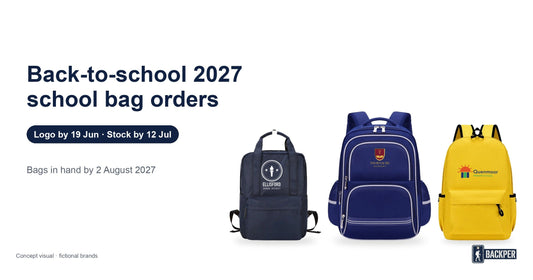
The single biggest mistake school procurement teams make is starting too late. A typical wholesale school backpack production calendar runs:
- February to March: finalize spec and supplier; submit deposit.
- March to April: pre-production samples and approvals.
- May to June: production.
- July: shipment and customs clearance.
- August: distribution to schools or students.
Compressing this timeline is possible but expensive — air freight, expedited production, and reduced sample rounds all add risk. Starting in February for August distribution is the most cost-effective path.
Distribution and Inventory Considerations
How the backpacks get from the shipping container to students matters as much as the bags themselves. For multi-school district programs, individually polybagged backpacks make sorting easier at the warehouse. Pre-kitting with notebook, pen, and welcome card sets adds cost but saves significant labor at distribution time. For university orientation programs, consider color-coded outer cartons by college or dorm to streamline pickup.
Frequently asked questions
What is the typical MOQ for bulk school backpacks?
Our minimum is 50 units per style, and you can mix colors within a style toward it. Volume discounts start at 15 percent at 50 units and rise to 29 percent at 1,000 units and above. Send your sizes and quantities for exact figures.
Do you ship worldwide?
Yes, worldwide, with DDP options that include freight and duties to your door — typically 14 to 21 days in production followed by 5 to 9 days in transit.
Order Your Wholesale School Backpacks With Backper
Backper produces wholesale school backpacks for school districts, private schools, and universities worldwide. We support every grade level from pre-K through university, all major safety and compliance standards, full custom color matching, and high-volume embroidery for school crests and personalized names.
Browse the School collection and Kids collection for current silhouettes, view bulk pricing, or contact our wholesale team for a quote tailored to your enrollment numbers and program timeline. We respond within 4 hours.
Tags:
Previous
Custom Branded Backpacks for Corporate Gifting and Employee Onboarding: Complete Buyer's Guide
Next
Custom Backpacks for Promotional Marketing Campaigns: A Playbook for Agencies
Related articles


-
Jul 16 2026