


A factory in Taichung is melting fishing nets and PET bottles pulled from the South China Sea into a 92% recycled ripstop that's now used in 38% of our outdoor catalog.
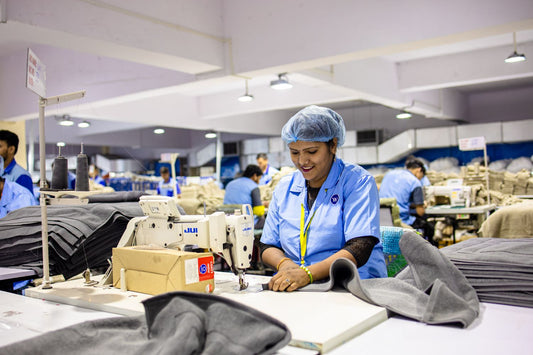
We spent four days on its floor, watching raw ocean plastic become the fabric on your back.
The intake yard smells like the sea
The first thing you notice isn't the machinery. It's the bales. Ghost nets, bottle caps, shredded buoys — compressed into cubes and stacked three high, still crusted with salt. Each bale is tagged with GPS coordinates from the collection vessel that landed it, because traceability is the entire business model here. If you can't prove the plastic came from the ocean, you can't sell it as ocean plastic, and the price difference between ocean-recovered and post-consumer PET is real: roughly 40% at current resin prices.
Abandoned, lost, and discarded fishing gear — the ghost nets in those bales — makes up around 10% of ocean plastic litter by weight, an estimated 640,000 tonnes a year, per a joint FAO/UN Environment Programme assessment. It's an older figure (2009) and we haven't found a more recent global estimate that carries the same weight of citation, but it's the number that explains why a factory would bother building a whole depolymerization line just for fishing net, instead of sticking to the much easier PET-bottle stream.
The yard processes about 30 tonnes a week. Nets are the hard part. PET bottles are a known quantity — wash, flake, melt, extrude. Nylon-6 fishing nets need depolymerization, a chemical process that breaks them back down to caprolactam before they can be re-spun. The Taichung facility does both under one roof, which is rarer than it should be.
From flake to filament
The transformation happens in stages that are oddly beautiful to watch. Washed flake goes into extruders that look like industrial pasta machines, producing continuous filament that's stretched, textured, and spun onto bobbins the size of beer kegs. The 92% figure — the number we print on our hangtags — comes from mass balance: 92% of the polymer input by weight is ocean-recovered, with the remaining 8% being virgin nylon added for tenacity in the warp.
That 8% matters. Early full-recycled ripstops failed our abrasion tests at roughly 60% of the cycles virgin fabric survived. The blended yarn closes that gap to within 5%, which is inside the margin we're willing to defend. We'd rather ship an honest 92% that lasts a decade than a fragile 100% that becomes landfill in two years.
What it costs, and what it changes
Ocean-recycled ripstop runs us about 1.6x the price of conventional fabric. On a typical 28L daypack, that's roughly $2.10 of additional material cost — meaningful at wholesale volumes, invisible in the retail price next to what marketing departments usually spend. We made the call in 2024 to absorb it across the outdoor line rather than break it out as a premium SKU, and the category has grown every quarter since.
The supply chain effect is the quieter story. Because ocean plastic supply is constrained by collection capacity, fabric mills now sign multi-year offtake agreements with collection fleets — which means fishing communities in the Philippines and Vietnam have a predictable buyer for what used to be waste they paid to dispose of. The supply chain isn't just cleaner; it points in a different direction.
Where this goes next
38% of our outdoor catalog uses this fabric today. The constraint isn't demand — it's depolymerization capacity, and two more lines are being commissioned in Taichung as we write this. Our sourcing team's projection is that we cross 60% of the outdoor line by late 2027, and we'll publish the number either way in next year's sustainability report.
The four days on that factory floor recalibrated how we think about "recycled" as a label. It's not one thing. It's a chain of custody, a chemistry problem, and a price negotiation — and the difference between marketing and material science is whether you can walk the floor and watch it happen.
The one outside number in this piece: ghost fishing gear is estimated at ~10% (640,000 tonnes/year) of ocean plastic litter by weight — FAO/UNEP, 2009, the most-cited figure in this space though not a recent one. Every other figure here (92% mass balance, 30 tonnes/week, abrasion test results, $2.10/pack, 1.6x cost, 38% catalog share) is our own factory-floor reporting and internal test data, not a third-party citation — presented as first-hand, not independently audited.
Related reading: For the sustainable-materials spec we build into wholesale programs, see our Wholesale guide Eco-Friendly Wholesale Backpacks. And for the full lifecycle numbers behind our sustainability claims, see Behind the sustainability report: what the numbers actually mean.
Tags:
Related articles

-
Jun 03 2026
We made every pack 2mm wider. Returns dropped 18%.
-
Jun 03 2026
Northwind Outdoor: 14 stores, one private-label catalog.
-
Jun 03 2026
The strange physics of webbing under shock load.
-
Jun 03 2026